Acid-Assisted Polymerization: novel synthetic route of semi-conducting polymer preparation
Abstract
There is a demand for a simple and reliable method for the synthesis of conjugated polymers with controllable morphologies and properties tailored to their applications in various devices. Several methods have been developed for the preparation of semiconducting polymers (SPs), including chemical oxidative polymerization, electrochemical polymerization, metal-catalyzed coupling, solid-state polymerization, Lewis acid–assisted polymerization, photoinduced polymerization, and oxidant-free acid polymerization at elevated temperatures.
In chemical oxidative polymerization, various oxidants are employed to initiate the polymerization of monomers. However, this method suffers from difficulties in separating the resulting polymer from residual oxidants and may lead to water contamination [1,2].
Among semiconducting polymers, polyaniline (PANI), polypyrrole, polyindole, and poly(3,4-ethylenedioxythiophene) (PEDOT), as well as their derivatives, are the most extensively studied materials due to their broad application potential in adsorption, catalysis, gas sensing, composite fabrication, and energy-related devices. Their attractiveness arises from several advantages, including low cost, good environmental stability, and excellent performance.
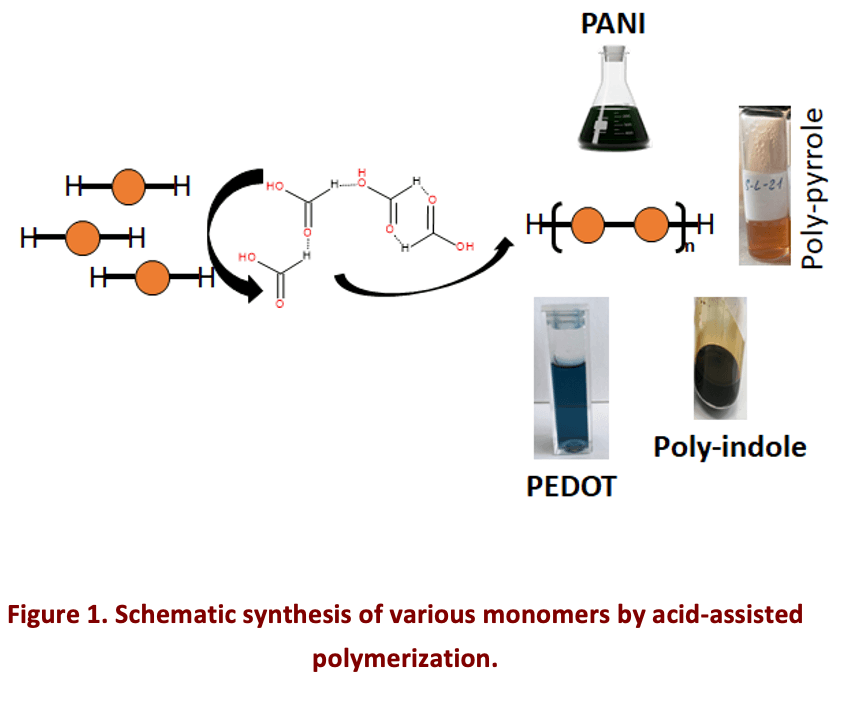
Herein, we report for the first time a simple acid-assisted polymerization method for the synthesis of PEDOT [1], polyindole, PANI [2,3], and their derivatives, resulting in the formation of a stable solution at room temperature with a quantitative yield (100%) (Figure 1). The resulting polymer suspension can be readily deposited onto a variety of substrates via simple solvent evaporation, enabling applications ranging from biosensors to pseudocapacitors. Moreover, we demonstrate that this self-polymerization approach does not generate detectable by-products, rendering the method environmentally benign.
References
1- E. Tomsik, I. Ivanko, J.Sovoda, I. Šeděnková, A. Zhigunov, J. Hromádková, J. Pánek, M. Lukešová, N. Velychkivska, L. Janisova Macromol. Chem. Phys. 2020, 2000219.
2- R. Ismail, I. Šeděnková, J.Sovoda, M. Lukesova, Z. Walterova, E. Tomsik J. Mat. Chem. B. 2023, 11,1545–1556.
3- M. Ennouri, J. Svoboda, Z. Moravkova, J. Hromadkova, E. Tomsik Nanoscale. 2025, 17, 22203–22217.
Acknowledgments
The study was co-funded by the project New Technologies for Trans-lational Research in Pharmaceutical Sciences /NETPHARM, project ID CZ.02.01.01/00/22_008/0004607, co-funded by the European Union.