Vitamin B₂ as a polymerization switch: Why control holds and why it fails in metal-free ATRP
Abstract

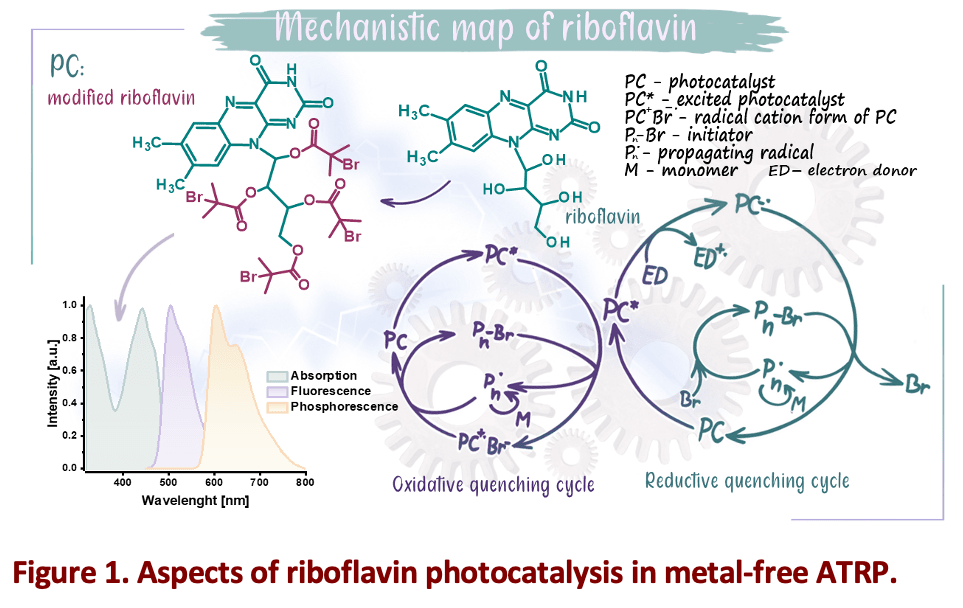
Riboflavin (RF), widely known as vitamin B2, possesses distinctive properties that arise from its molecular architecture. The tricyclic isoalloxazine chromophore, characteristic of the flavin family, dictates its photophysical and redox properties. This heteroaromatic ring system enables reversible one- and two-electron transfer pathways and displays strong UV-Vis absorption, together with a relatively long-lived triplet excited state that underlies both its photosensitivity and photocatalytic performance. The ribitol side chain offers opportunities for synthetic modifications (e.g., introduction of initiating groups), enabling the use of vitamin B2 as a photoactive driver in photopolymerization, leading toward functional polymeric materials [1,2]. The successful RF application in free-radical polymerization systems prompted interest in evaluating its potential for photoinduced reversible deactivation radical polymerization (RDRP), specifically in metal-free atom transfer radical polymerization (metal-free ATRP) – a technique that eliminates metal-based catalytic complexes. The success of metal-free ATRP driven by bio-derived photocatalysts depends on a well-defined mechanistic understanding [3,4]. In our work, we present a detailed mechanistic map for riboflavin and brominated riboflavin derivatives as organic photocatalysts in metal-free ATRP. By integrating spectroscopic and electrochemical characterization with polymerization kinetic studies, we established structure-property relationships that explain when and why control is maintained or lost. The findings highlight riboflavin’s potential as a visible-light photocatalyst while underscoring its sensitivity to the solvent environment (polarity, hydrogen-bond donation), and photodegradation (Figure 1). Analysis revealed the origins of uncontrolled processes occurring through both oxidative- and reductive-quenching pathways and identified strategies to partially suppress these side reactions. Bromination of the ribitol tail yielded a dual-function reagent – serving as a photocatalyst through the intact isoalloxazine chromophore and as an initiator due to bromine substituents. That provided a cost-effective approach and offered improved control compared to the unmodified molecule. Using this platform, branched poly(methyl methacrylate)s bearing two, three, and four side chains were successfully synthesized. Owing to the accessibility and low cost of flavin chromophores, these results define practical operating windows and pathways for further chromophore and microenvironment optimization – advancing efficient, sustainable, and externally switchable metal-free photopolymerization, capable of controlled chain growth under visible light.
References
1- D. Seo, S. Kwon, G. Yoon, T. Son, C. Won, N. Singh, D. Kim, Y. Baek Nat. Commun. 2025, 16 (1), 3561.
2- I. Zaborniak, P. Chmielarz Eur. Polym. J. 2021, 142, 110152.
3- H. I. Coskun, T. Vortuba-Drzal, H. Wu, S. Jockusch, G. Yilmaz, K. Matyjaszewski Macromol. Chem. Phys. 2025, 226 (7), 2400323.
4- S. Soly, B. Mistry, C.N. Murthy, Polym. Int. 2022, 71(2), 159.
Acknowledgments
Financial support from National Science Centre in Poland as a part of the SONATA BIS 10 project (no: 2020/38/E/ST4/00046).