The flame-retardant mechanism of α-amino acid-derived polyamidoamines on cotton: insights from magnetic resonance spectroscopies
Abstract
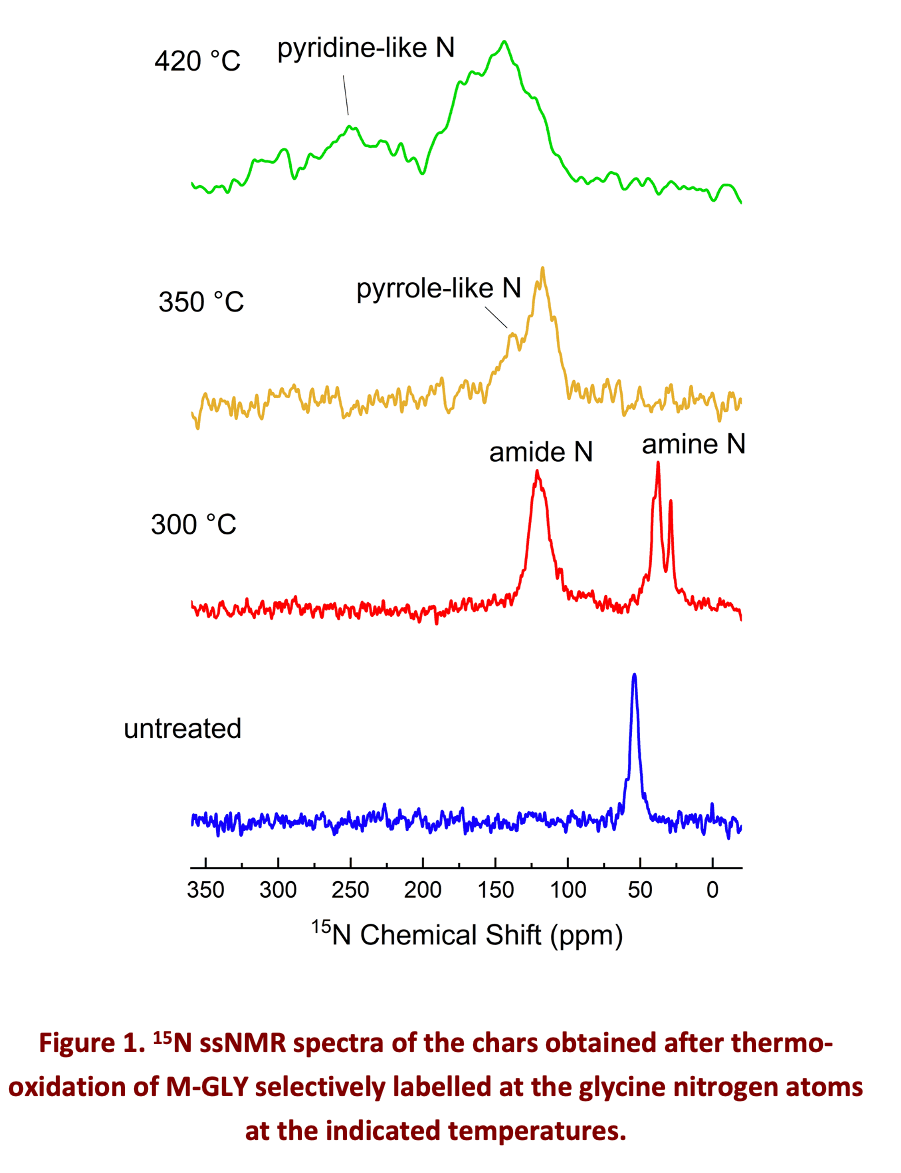
Natural α-amino-acid-derived polyamidoamines (PAAs), based on glycine (M-GLY), cystine (M-CYSS), and glycine/cystine (M-GLY50-CYSS50) are recognized as intumescent flame retardants for cotton. The structure and composition of chars obtained from thermo-oxidized PAA-impregnated cotton, pristine PAAs and cotton were analyzed to elucidate the condensed-phase flame retardant action mode. Thermo-oxidation was performed at 300, 350, and 420 °C and the resulting chars were characterized by solid-state NMR (ssNMR) and EPR spectroscopies [1]. To gain insight into the degradation pathways of M-GLY, the fate of the glycine carbon and nitrogen atoms was tracked by applying ssNMR to M-GLY selectively labeled with ¹³C and 15N (Fig. 1).
The observed structural transformations of PAAs are consistent with decomposition pathways initiated by early depolymerization and homolytic cleavage, followed by decarboxylation, deamination, and cyclization, ultimately leading to progressive enrichment in heteroatom-depleted aliphatic structures and the formation of aromatic domains. In cotton/PAA systems, PAAs were found to form a protective char layer on the cotton surface at 300 °C, while the cotton substrate itself remained largely unaffected. At 350 °C, PAAs slowed the oxidative decomposition of cotton, most likely by limiting heat and mass transfer (oxygen and volatiles), with protection efficiency following the order M-GLY > M-CYSS > M-GLY50-CYSS50. At 420 °C, distinct PAA-derived char layers were observed on the cotton surface. M-GLY produced a char characterized by larger aromatic domains compared to M-CYSS and M-GLY50-CYSS50, as evidenced by dipolar-dephased 13C CP NMR experiments, and by smaller pores, as indicated by ¹H MAS NMR measurements. These structural features may account for its recognized superior protective performance towards cotton in horizontal flame tests.
References
- M. Pierigé, M. Arioli, J. Alongi, E. Ranucci, C. Forte, S. Pizzanelli Colloids Surf. A 2026, 728, 138787.
Acknowledgments
All the authors acknowledge financial support from the Italian Ministry of University and Research (project PRIN 2022 FLARECO - Eco-friendly, washing-durable FLAme-REtardant finishing for cotton fabrics by COvalent grafting of α-amino acid-derived polyamidoamines, 202237JYZN).