Tailor-made pH-responsive branched polymers for controlled release systems
Abstract
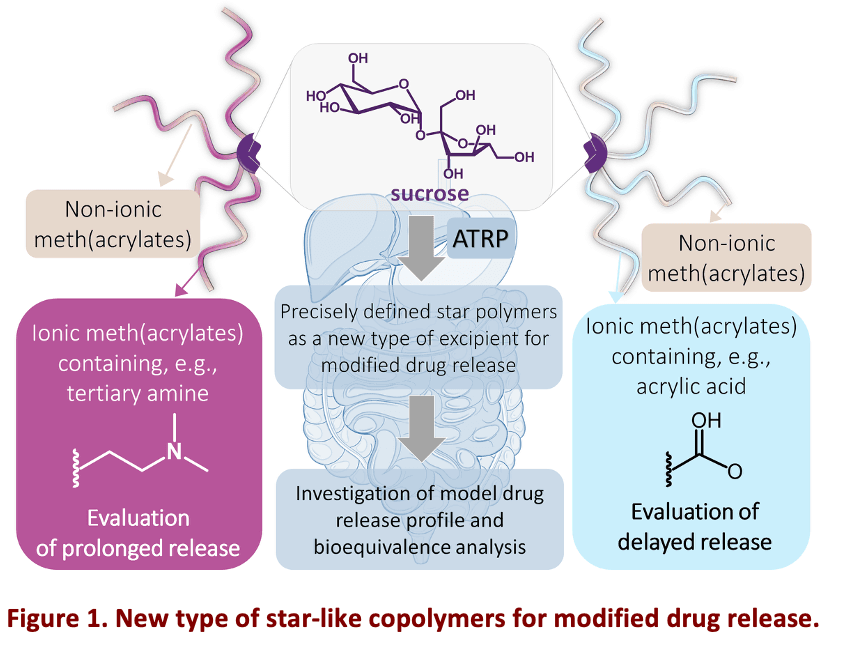
pH-responsive polymers were developed and investigated as advanced platforms for modified drug release, with particular emphasis on controlled release within the gastrointestinal tract. These systems were designed to regulate the timing, rate, and site of drug release relative to those of immediate-release formulations. Ionizable moieties, such as acrylic acid and tertiary amines, govern polymer swelling, degradation, and drug-matrix interactions, therefore, a pH-triggered release profile [1, 2]. Currently, commercially available pH-responsive excipients are primarily linear (meth)acrylate-based polymers containing ionic moieties [3]. Our research hypothesizes that the efficiency and packing of active substances within modified-release excipients can be significantly improved by employing branched architectures. Star-shaped polymers with natural-origin cores, such as sucrose functionalized to carry multiple polymer chains, offer exceptionally high densities of reactive groups. Their use may reduce the overall excipient content and tablet mass, improving patient comfort while lowering manufacturing costs. For pharmaceutical applications, excipients must exhibit precisely defined, reproducible structures to ensure pharmaceutical and biological equivalence, both of which are essential for therapeutic equivalence. Inconsistent polymer architecture can affect drug absorption and bioavailability. Therefore, the synthesis of branched polymers requires a manufacturing approach capable of delivering consistent and uniform materials. To meet this requirement, we employ atom transfer radical polymerization (ATRP), which provides precise control over polymer topology and composition [4]. Therefore, our current work focuses on ATRP-based functionalization of sucrose to obtain star-like polymers with copolymer arms containing acrylic acid or tertiary amines, and complementary non-ionic components that enhance solubility, biocompatibility, and material stability. We systematically analyze how polymer composition, ionic content, and non-ionic segments influence physicochemical properties and pH-dependent release profiles of model active substances. These studies highlight the potential of tailored branched polymers as innovative excipients for delayed and sustained drug release.
References
1- J. K. Patra, G. Das, L. F. Fraceto, E. V. R. Campos; M. d. P. Rodriguez-Torres; L. S. Acosta-Torres, L. A.Diaz-Torres, R. Grillo, M. K. Swamy, S. Sharma, S. Habtemariam, H.-S. Shin J. Nanobiotechnology 2018, 16, 71.
2- Z. Wang, X. Deng, J. Ding, W. Zhou, X. Zheng, G. Tang Int. J. Pharm. 2018, 535, 253.
3- L. J. Kubiatowicz, N. Pourafzal, A. T. Zhu, Z. Guo, R. H. Fang, and L. Zhang Small Methods 2026, 10, 2500624.
4- M. Sroka, I. Zaborniak, P. Chmielarz ACS Biomater. Sci. Eng. 2025, 11, 4694.
Acknowledgments
All the authors acknowledge financial support from the National Centre for Research and Development as part of the LIDER XIV project (no. LIDER14/0058/2023).