Sustainable thermosetting foams from vegetable oil via microwave-assissted processing
Abstract
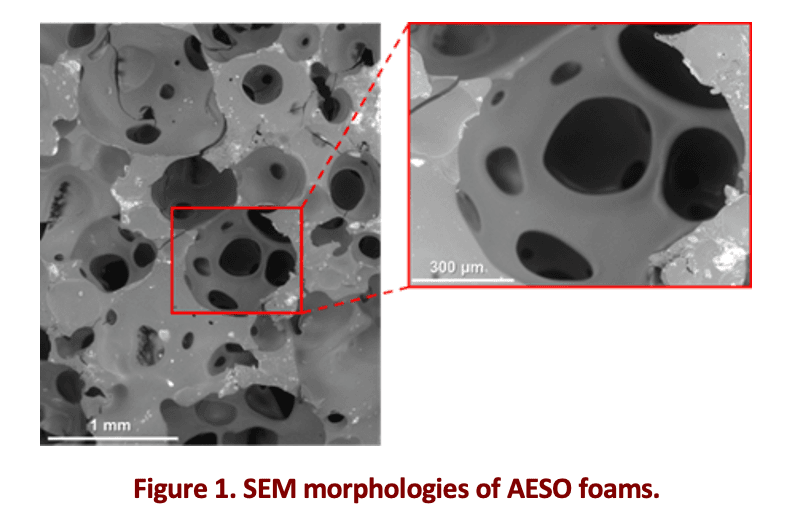
Vegetable oils represent ideally renewable, abundant, and low-cost feedstocks for the synthesis of sustainable polymers exhibiting diverse structures, properties, and applications. Their inherent molecular complexity, stemming from their carbon backbones, unsaturations, and array of functional groups, offers a significant opportunity for the development of novel materials.[1] Furthermore, the utilization of waste cooking oil as a pre-cursor for bio-based materials presents a compelling alternative to the consumption of virgin vegetable oils, offering substantial cost reductions while aligning with principles of waste valorization and sustainability.[2] In the present study, acrylated epoxydized soybean oil (AESO) was used in the preparation of thermosetting foams cured via a free-radical polymerization mechanism initiated by tert-butyl peroxybenzoate (Luperox® P) and sodium bicarbonate, as blowing agent, under microwave (MW) irradiation at 800 W for 2 minutes. Unlike conventional heating, MW energy directly couples with polar molecules, enabling rapid and volumetric heating of the resin. Therefore, MW irradiation offers a precise and efficient method for temperature control during the crosslinking of foams. The influence of rheological properties during the pre-curing and the MW processing parameters on the resulting cellular morphology of AESO foams was investigated. In detail, cellular growth was observed to be promoted under conditions where the viscosity of the liquid phase was sufficiently elevated to reduce coalescence and coarsening, and where the crosslink density was adequately low to permit foam expansion. Moreover, the thermal stability and mechanical properties of AESO-based foams were studied by thermogravimetric analysis and compression tests. The optimal cellular morphology of foam (Fig. 1), characterized by a density of 0.37 g/cm3, an average cell size of 190 μm and an elastic modulus of 1.8 MPa, was achieved by arresting the pre-curing phase immediately prior to the gel point of resin. [3] On the basis of such results, that demonstrate the potential of microwave-assisted production of bio-based AESO foams with tailored performance, we explored the use of a terpenic comonomer, i.e. myrcene. The influence of myrcene on rheological properties of AESO was studied in order to optimize the foaming process. Moreover, the resultant AESO/myrcene foams were thermally and mechanically characterized.
References
1- F. Bertini, A. Vignali, M. Marelli, N. Ravasio, F. Zaccheria Polymers 2022, 14, 4185.
2- B. Palucci, A. Vignali, N. Ravasio, F. Zaccheria, F. Bertini Macromol. Symp. 2024, 413, 2300237.
3- A. Vignali, F. Bertini, S. Iannace ACS Omega 2025, 10, 56715.
Acknowledgments
Thanks are due to the Extended Partnership PE00000004 “Made in Italy Circolare e Sostenibile” (MICS) project, funded by the European Union-Next Generation EU, for financial support.