Supramolecular materials from trisureas-based polymers self-assembly: how big can it get?
Abstract
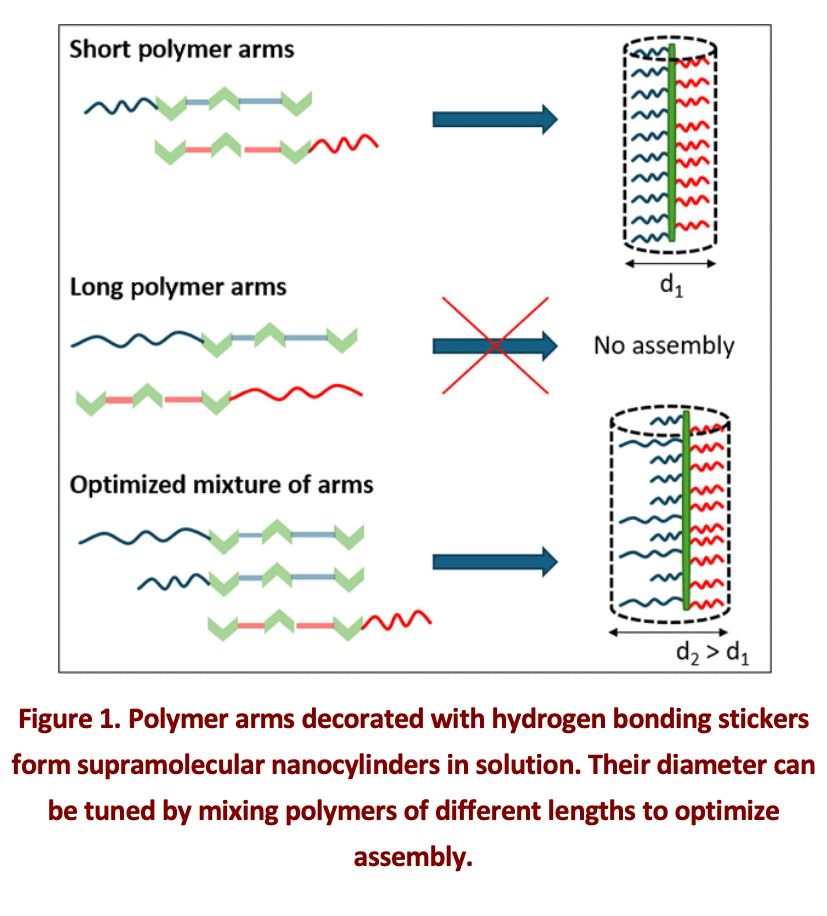
Nanocylinders find applications in biology, catalysis, and material science due to their high aspect ratio and nanometric diameter, granting them a high specific area. They can be formed by supramolecular assembly in solution of polymers decorated by stickers promoting directional assembly. Controlling the dimensions of nanocylinders impacts their applicative properties. Many strategies exist to tune their length, but much fewer to tune their diameter. We address this point here by synthesizing water-soluble polymers of different lengths end-functionalized by hydrogen bonding tris(urea) stickers. It is shown through a combination of light/neutron scattering experiments and cryo-transmission electron microscopy that short polymer arms (DP ≤ 80) produce thin (d = 10 nm) and long (L > 500 nm) nanocylinders, whereas longer polymer arms (DP ≥ 500), required to significantly increase d, inhibit self-assembly due to the strong entropic penalty caused by their stretching. Special attention will be given to synthesis of these complex stickers based on tris(ureas) along with their supramolecular assembly.
References
1- S. Kalem, M. Ji, A.V. Gonzalez, D. Siefker, J.M. Guigner, R. Schweins, S. Pensec, J. Rieger, L. Bouteiller, E. Nicol, O. Colombani J. Pol. Sci. 2025, 63, 4436.
Acknowledgments
This work was supported by Agence Nationale de la Recherche in the frame of the ANR project JAROD (ANR-21-ce06-0017)