Safe & sustainable by design phenolic resins, toward a continuous synthesis process
Abstract
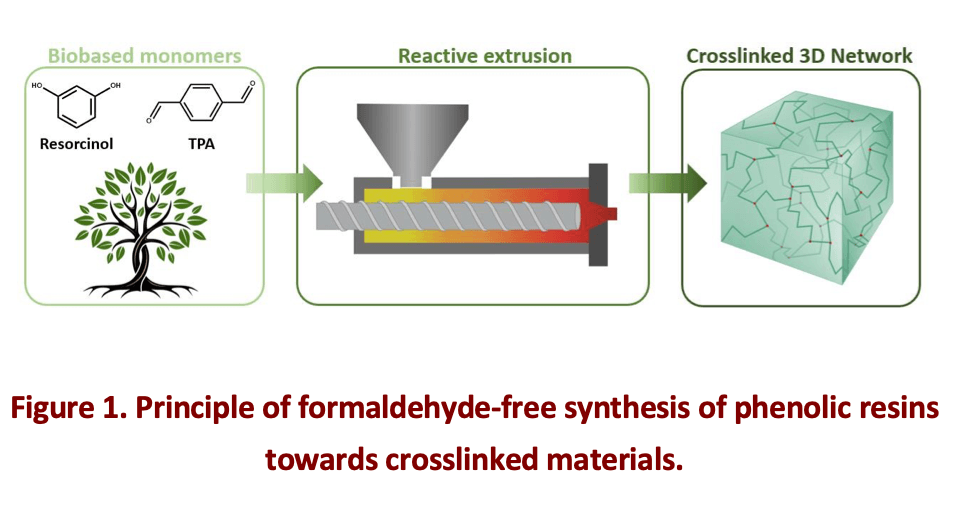
Formaldehyde is an important building block in a wide range of applications such from wood adhesives to high performance composites. As a class 1B CMR compound, regulators tend to restrict its use, the consumer’s exposure and expect companies to show a clear commitment to phasing out formaldehyde and implementing safer substitutes [1]. Phenolic resins are the oldest synthetic polymers ever industrialized, and since early XXth century, has never ceased being used [2]. Obtained by polycondensation, it is usually synthesized under batch conditions, using solvents for the control of the viscosity. Our work and recent literature report on the use of formaldehyde alternatives, especially for high performance polymers. Focusing on aromatic aldehydes, promising substitutes can be highlighted, without any compromise on the applicative range, either in terms of thermomechanical properties, or in term of processing ability[3,4]. In our work, while selecting safer monomers for phenolic resins synthesis, we developed a solventless continuous synthesis method, using reactive extrusion [5]. With this processing technique, we are able to control the reactivity by tuning different extrusion parameters, and with the help of catalysis. We also used kinetic modeling in order to predict the suitability of phenol-aldehyde formulation to extrusion process. Our work paves the way for continuous and solventless synthesis of formaldehyde-free phenolic resins, allowing a reduction in solvent usage, and using less toxic monomers, without sacrificing materials performances.
References
1- Commission Regulation (EU) No 605/2014 of 5 June 2014 amending Regulation (EC) No 1272/2008 of the European Parliament and of the Council on classification, labelling and packaging of substances and mixtures. OJ L., 2014, Vol. 167.
2- L. Pilato React. Funct. Polym. 2013, 73, 270.
3- L. Granado, R. Tavernier, S. Henry, R.O. Auke, G. Foyer, G. David, S. Caillol ACS Sustain. Chem. Eng. 2019, 7, 7209.
4- L. Granado, R.R. Foyer, G. David, S. Caillol Thermochim. Acta 2018, 667, 42.
5- A. Maokhamphiou, M. Zinet, W. Guerin, A. Soisson, M. Petit, G. Jobard, F. Da Cruz-Boisson, K. Delage, R. Tavernier, V. Bounor-Legaré Green Chem. 2025, 27, 3887.
Acknowledgments
All the authors acknowledge financial support from ANRT (Agence Nationale de la Recherche et de la Technologie).