Production and characterization of rPET-based microcellular polymers
Abstract
The industrial recovery of recycled polyethylene terephthalate (rPET) is frequently hindered by its inconsistent composition and compromised melt rheology, typically resulting in low-value downcycling [1-2]. This study explores an alternative upcycling pathway by transforming two distinct industrial streams: light-blue rPET and highly heterogeneous colored rPET into microcellular films using a two-step gas dissolution foaming process [3].
By conducting a systematic study, the foaming window of the materials is stablished. The optimum foaming procedure consisted on first saturating the samples with CO2 at 15 MPa and 50 °C for 69 hours. Following a rapid depressurization, the expansion was activated by immersing the gas-saturated films into a thermal oil bath at 200 °C for 1 minute. This decoupled approach allowed for precise control over the nucleation and growth stages, overcoming the typical processing challenges associated with the low melt strength of recycled materials.
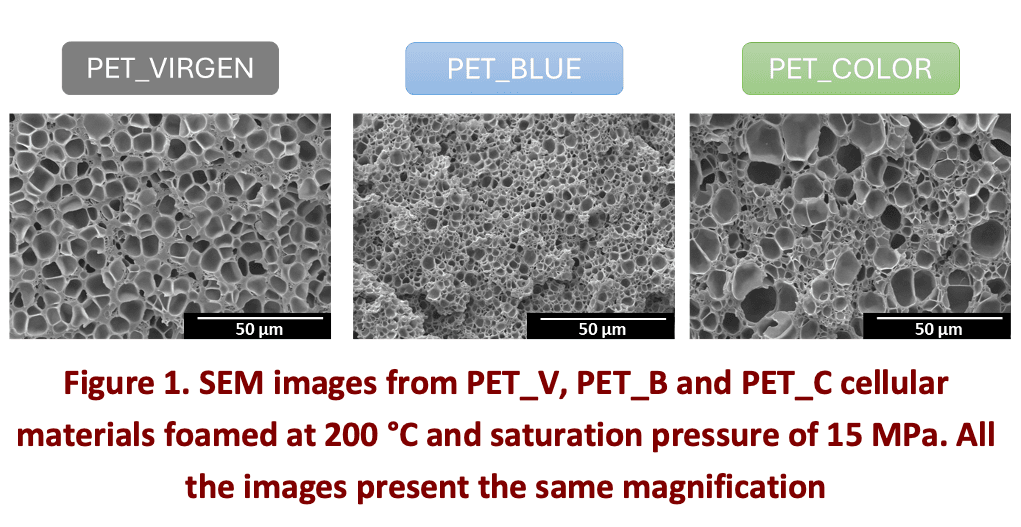
The results demonstrate a remarkable morphological control, as shown in Fig. 1. PET_B yielded a refined microcellular structure with cell sizes near 2 microns and relative densities as low as 0.20 to 0.28, effectively outperforming virgin PET benchmarks. Notably, even with the presence of non-miscible contaminants, PET_C produced stable cellular architectures with diameters ranging from 5 to 18 microns. The ability to maintain structural integrity at high expansion temperatures suggests that the localized crystallinity and gas concentration effectively stabilized the polymer matrix during the rapid foaming phase.
This research underscores the robustness of the gas dissolution technique as a high-value upcycling route for heterogeneous plastic waste. By converting low-grade rPET into high-performance, lightweight microcellular materials, this work provides a scalable strategy for integrating complex waste streams into advanced engineering applications, directly supporting global circular economy objectives and sustainable manufacturing.
References
1- P. M. Nguyen, C. Berrard, N. Daoud, P. Saillard, J. Peyroux, O. Vitrac Resour. Environ. Sustain. 2024, 17, 100163.
2- T.M. Joseph, A. Esmaeili, S. Azat, E. Kianfar, Z. Ahmadi, J. Haponiuk, O.M. Jazani, S. Thomas CSCEE 2024, 9, 100673.
3- M. Merillas, J.C. Merino, J. Lledó, M. Santiago-Calvo, M.A. Rodríguez-Pérez Mater. Today Sustain. 2026, 34, 101352.
Acknowledgments
Financial support from grant PID2024-157392OB-I00 funded by MICIU/AEI/ 10.13039/501100011033 and, by “ERDF/EU” and grant PDC2025-165502-I00 funded by MICIU/AEI/ 10.13039/501100011033 and, by the “European Union NextGenerationEU/PRTR” are gratefully acknowledged. Financial support from the Ministry of Economy and Competitiveness (MINECO) of Spain through the PTQ2021-011628 project (M. Santiago-Calvo) is gratefully acknowledged.