Polyelectrolyte-based coatings for flame retardant applications
Abstract
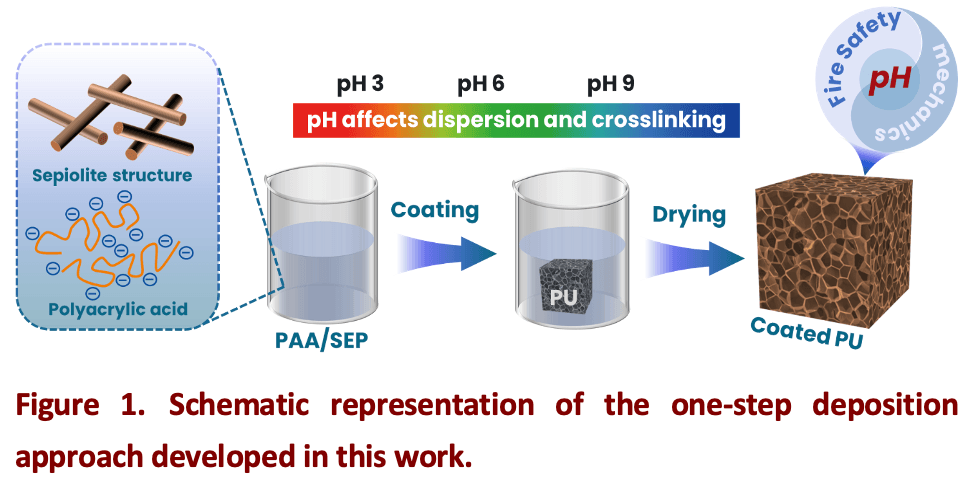
Polyurethane (PU) foam is widely used in furniture and insulation due to its high strength-to-weight ratio [1,2], but its inherent flammability poses a significant fire hazard. This work aimed to address this issue by developing a simple, sustainable one-step coating with polyacrylic acid (PAA) and sepiolite (SEP), a natural clay mineral. By controlling deposition bath pH to 3, 6, and 9, the impact on coating formation and material properties was systematically investigated (Fig. 1). Indeed, PAA displays ionizable carboxyl groups in equilibrium between protonated (-COOH) and deprotonated (-COO⁻) states, depending on pH values [3]. Under acidic conditions, PAA chains adopt a coiled conformation due to limited negative charges; under alkaline conditions, electrostatic repulsion causes chain expansion [4]. ATR-FTIR confirmed this equilibrium, with the -COO⁻/-COOH ratio increasing from 0.14 to 7.50 as pH increased from 3 to 9 [1,5]. SEM showed coated foams displayed a continuous coating layer with pH-dependent morphology. This affects mechanical properties as pH 3 treated foams displayed a stiffer and firmer behavior than foams coated at pH 6 and 9.
Flammability tests showed how samples coated at pH 3 and 9 self-extinguished the flame within seconds while pH6 samples were not able to stop flame propagation. By forced combustion tests, the best performance was achieved by coatings deposited at pH=3 with a 48% reduction in peak heat release rate with respect to the uncoated foam. This was attributed to the acidic functionalities of PAA that promoted the formation of a thermally stable protective barrier embedding SEP. These results clearly demonstrate the versatility and tunability of the proposed pH dependent deposition.
References
1- L. Maddalena, L. Shtrepi, M. Marcioni, A. Fina, F. Carosio, Stacked graphene oxide and bio-sourced polyelectrolyte complexes thin coating for fire safe and sound absorbing flexible foams, Polymer Degradation and Stability 240 (2025) 111469.
2- F. Carosio, L. Maddalena, J. Gomez, G. Saracco, A. Fina, Graphene oxide exoskeleton to produce self‐extinguishing, nonignitable, and flame resistant flexible foams: A mechanically tough alternative to inorganic aerogels, Adv Materials Inter 5 (2018) 1801288.
3- D. Zhang, J. Liu, B.L. Williams, Z. Hou, J.N. Bodin, B.J. Lofink, V.H. Santos, E.M. Becher, S.B. Shrestha, Z. Nasir, H. Patel, A. Partyka, X. Peng, L. Sun, Enhancing flame retardancy of flexible polyurethane foams through one-step coassembled nanocoatings, Adv Compos Hybrid Mater 7 (2024) 230.
4- J. Dong, Y. Ozaki, K. Nakashima, Infrared, raman, and near-infrared spectroscopic evidence for the coexistence of various hydrogen-bond forms in poly(acrylic acid), Macromolecules 30 (1997) 1111–1117.
5- J. Wang, S. Ren, M. Guo, Preparation and humidity controlling behaviors of sepiolite/polyacrylic acid (sodium) composite, Procedia Engineering 27 (2012) 423–430.
Acknowledgments
All the authors acknowledge financial support from the China Scholarship Council (CSC) under Grant No. 202408340005.