PLLA-based biocomposites produced in one step synthesis from the monomer by TP-RTM
Abstract
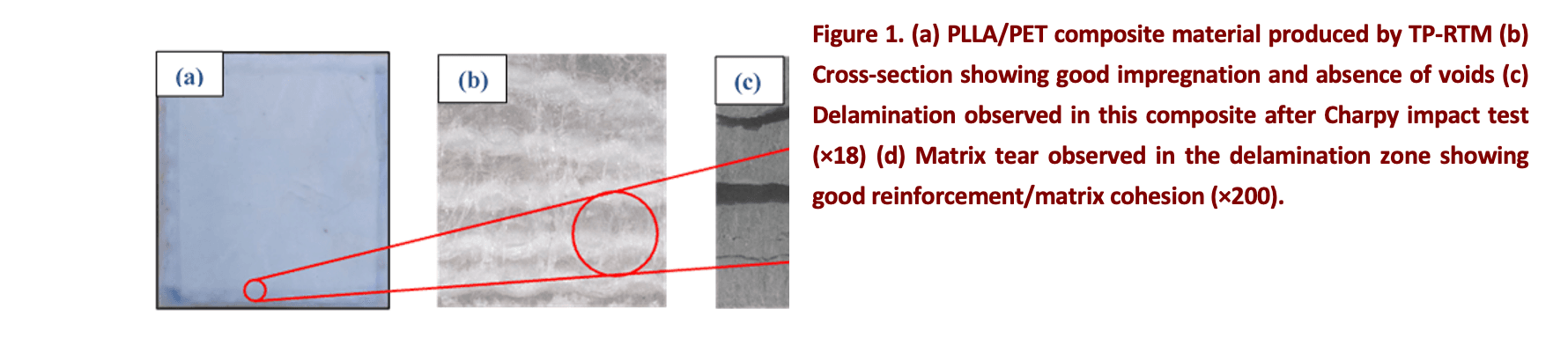
The development of biopolymers is increasing in a context of sustainable development, leading to the search for alternatives to petroleum-based polymers. Among these, bio-based, biocompatible, and industrially compostable poly(L-lactide) (PLLA) [1], currently accounts for 31% (by mass) of global biopolymer production and is widely used in the biomedical and packaging sectors [2]. However, its use in applications involving durable objects and parts is limited due to its low glass transition temperature (≈60°C) and low elongation at break (2-4%).[2] To overcome these limitations and broaden its fields of application, PLLA is increasingly used as a matrix in composites, resulting in materials with good thermo-mechanical properties [3]. Recent work involving the TP-RTM (Thermoplastic Resin Transfer Molding) process for the production of solvent-free composite materials via in situ polymerization of the monomer has enabled the production of PLLA matrix composites reinforced with glass or flax fibers (fully compostable composites) with a fiber mass fraction of up to 50% [4-6]. Following this work, all-thermoplastic composites (matrix and reinforcement) with a PLLA matrix were produced using the TP-RTM process. The reinforcement is a PET fabric with 16 plies placed alternately at 0° and 90° in a closed mold under a heated press. The bulk polymerization of L-lactide (L-LA) is carried out in the presence of tin octoate. Composite plates (120×120×5 mm) were obtained with L-LA conversion > 95% and Mn > 122,000 g/mol, without apparent voids and with good cohesion between the reinforcement and the matrix. The mechanical recycling of these plates was then studied [7].
References
1- M. Jamshidian, E.A. Tehrany, M. Imran, M. Jacquot, S. Desobry Compr. Rev. Food Sci. Food Saf. 2010, 9, 552.
2- R. Auras, L-T. Lim, S.E.M. Selke, H. Tsuji, Poly(lactic acid): Synthesis, Structures, Properties, Processing, and Applications, 1st ed; John Wiley & Sons: N. J Hoboken, 2010, pp 67-153.
3- M. Murariu, P. Dubois, Adv. Drug Deliv. Rev. 2016, 107, 17.
4- E. Louisy, F. Samyn, S. Bourbigot, G. Fontaine, F. Bonnet,Polymers, 2019, 11, 339.
5- B. Miranda Campos, F. Fontaine, S. Bourbigot, G. Stoclet, F. Bonnet ACS Appl. Polym. Mater. 2022, 4, 6797.
6- B. Miranda Campos, J. Beauvois, G. Fontaine, S. Bourbigot, G. Stoclet, F. Bonnet Polym. Compos. 2024, 45, 13392.
7- J. Beauvois, B. Dutailly, A. L. Abubakari, F. Boussu, A. Cayla, F. Salaün, F. Bonnet. Submitted.
Acknowledgments
All the authors acknowledge financial support from CNRS, University of Lille and Fédération Lilloise de Mécanique.