Photoactivable alizarin and eugenol-based materials for antibacterial applications
Abstract

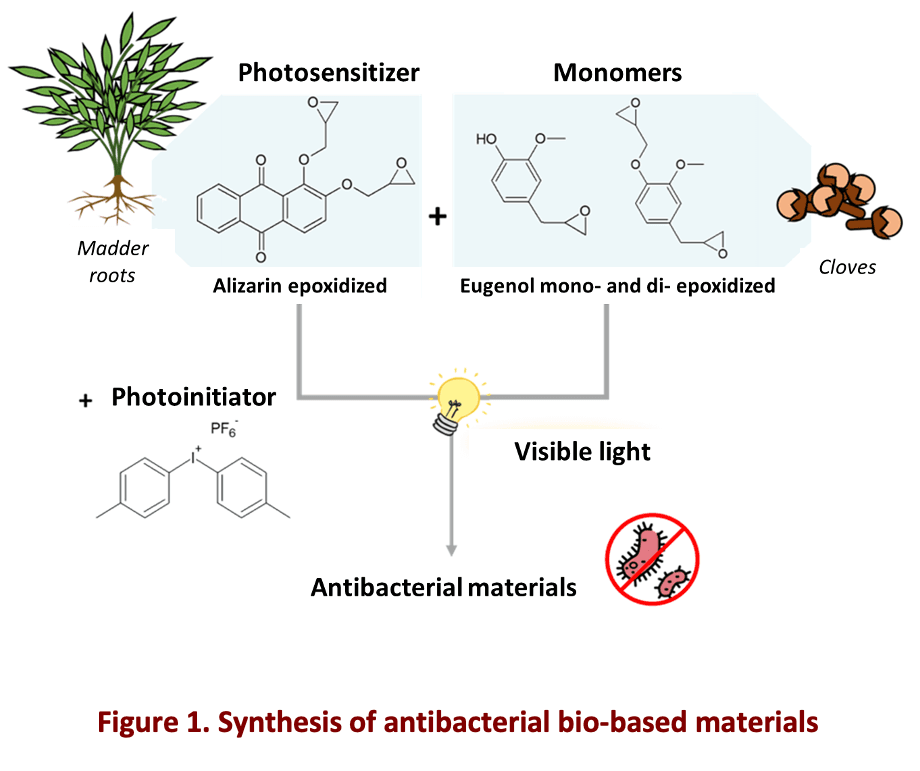
Photopolymerization seems to be an efficient strategy for the synthesis of polymeric materials under soft conditions, combining fast curing, solvent-free processes and reduced energy consumption. In this work [1], antibacterial bio-based polymers were developed by visible-light-induced cationic photopolymerization. Eugenol, a renewable phenolic compound naturally found in cloves, was chemically modified to obtain mono- and di-epoxidized derivatives. The presence of the phenol function on the mono-epoxidized eugenol contributes to the antibacterial properties of the resulting materials.
To further enhance their antimicrobial activity, a natural dye extracted from madder roots was functionalized with epoxy groups and incorporated into the network as a reactive photosensitizer. This epoxidized alizarin derivative efficiently initiates polymerization under visible light. Photophysical and photochemical investigations of the photoinitiating system were performed using fluorescence spectroscopy, spin-trapping EPR and laser flash photolysis.
Beyond polymer synthesis, the grafted photosensitizer enables antimicrobial activity through a photodynamic therapy process. Upon white light irradiation, the alizarin epoxidized derivative produces reactive oxygen species, including singlet oxygen, leading to efficient surface decontamination. Antibacterial tests conducted on Staphylococcus aureus and Escherichia coli demonstrated 100% of bacterial decontamination under irradiation, highlighting the potential of these bio-based materials for “self-disinfecting” surfaces (Fig. 1).
References
1- C. Elian, B. Quienne, S. Lajnef, F. Peyrot, R. Moilleron, S. Abbad Andaloussi, S. Caillol, D-L. Versace. Eur. Polym. J. 2023, 197, 112369