Phosphorus- nitrogen- and sulfur (P/N/S)-containing oligomer for enhanced flame retardancy of cotton
Abstract

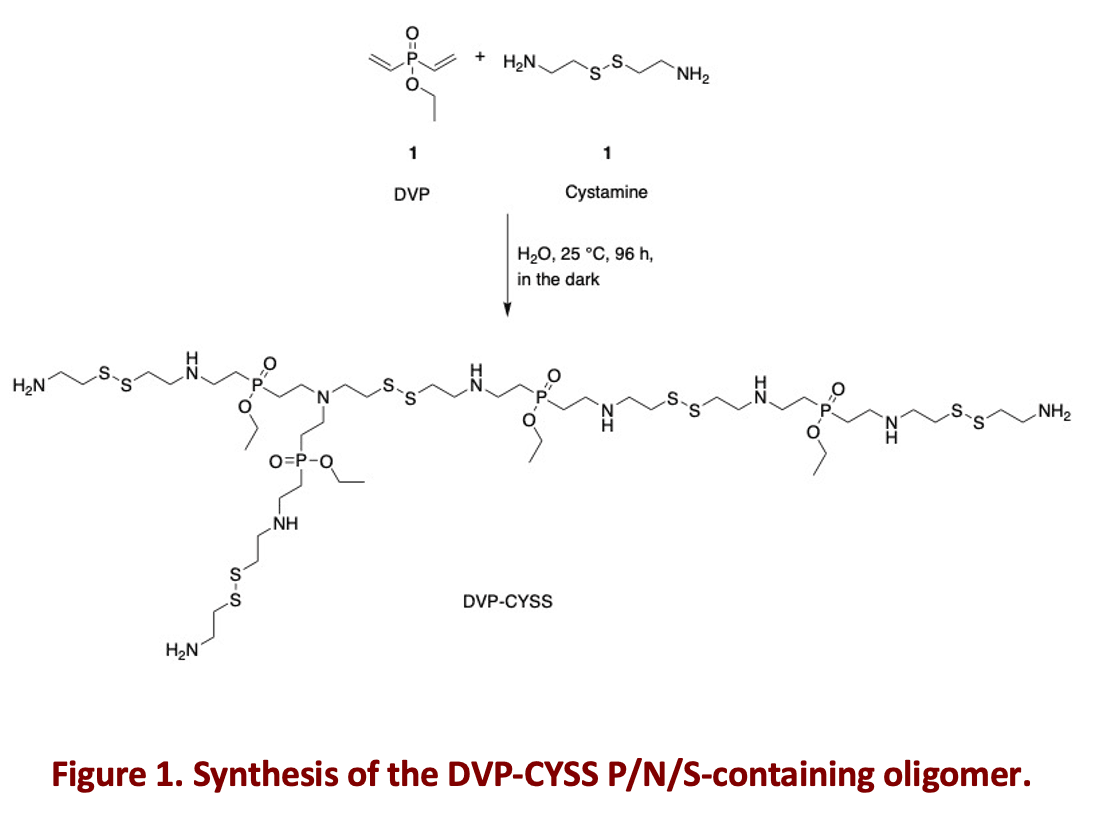
A phosphorus- nitrogen- and sulfur (P/N/S)-containing oligomeric flame retardant for cotton, designated DVP-CYSS, was synthesized via the polyaddition of divinyl ethylphosphinate with cystamine. Each repeat unit incorporates a disulfide linkage, two amine groups, and a phosphinate group. This molecular design aimed to evaluate whether integrating functionalities known to promote char formation in cotton into a single polymeric repeat unit could generate synergistic effects and thereby enhance flame retardant performance. Field Emission-Scanning Electron Microscopy observations indicated that the mechanical integrity of the cotton fibers is largely preserved upon deposition of DVP-CYSS at a 12.0% add-on. The flame retardant performance of DVP-CYSS was evaluated using multiple combustion tests, with M-CYSS, a disulfide-containing polyamidoamine lacking phosphorus groups, used as a benchmark. In vertical flame spread tests, DVP-CYSS outperformed M-CYSS, achieving higher efficacy and completely suppressing afterglow at add-ons between 8.0% and 16.0%. In horizontal flame spread tests, DVP-CYSS inhibited cotton combustion at a 10.0% add-on, whereas M-CYSS underwent thermo-oxidation for approximately 60 s. Oxygen-consumption cone calorimetry showed that DVP-CYSS reduced the peak heat release rate of cotton by 24% and the total smoke release by 65%, while yielding a 9% residual mass, in contrast to the negligible residue observed for untreated cotton.
Elemental analysis of chars by Energy Dispersive Spectroscopy showed that, while sulfur content decreased, likely due to S–S bond cleavage followed by oxidation and volatilization, phosphorus remained largely in the char, likely contributing to its action in the condensed phase.
Acknowledgments
research was funded by Università degli Studi di Milano, Piano di Sostegno alla Ricerca 2023, Linea 2.