Organolithium chemistry in continuous-flow miniaturized reactors: towards the synthesis of polymeric materials
Abstract
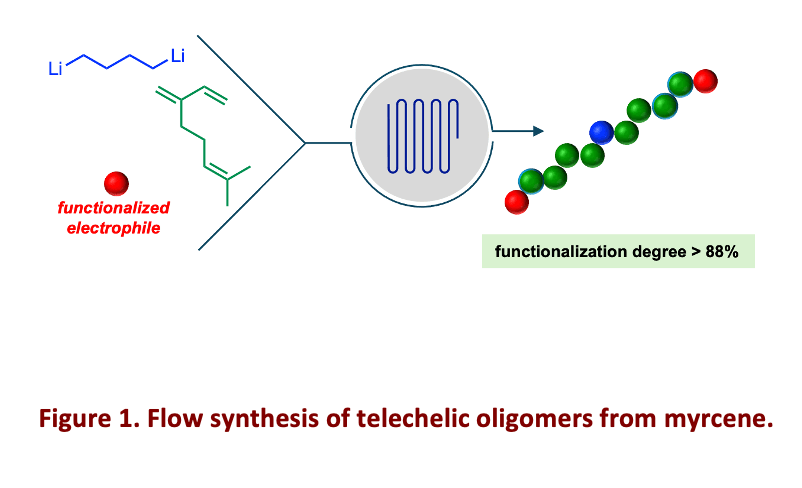
Organolithium chemistry in continuous-flow miniaturized reactors represents a groundbreaking approach for the precise and sustainable synthesis of polymeric materials. Our work initially focused on the anionic polymerization of biobased myrcene using n-BuLi in a microflow reactor, where superior heat and mass transfer enabled exceptional control over molar mass and polymerization conditions. This method effectively overcomes the uncontrolled exothermic behavior commonly encountered in batch reactors, allowing the synthesis of low molar mass polymyrcene (PMYR) with narrow dispersity and tailored properties.
To further expand the scope of this technology, we developed a versatile dilithiated initiator that enables bidirectional polymerization of myrcene within the same microflow setup. This advancement facilitates the production of telechelic oligomers with precisely defined chain-end functionalities. The flow system also allows for the efficient trapping of a wide range of electrophiles—such as aldehydes, ketones, imines, amides, disulfides, and carbon dioxide—resulting in α,ω-functionalized oligomers with high functionalization degrees. Notably, the selective introduction of CO₂ produced carboxylic acid-terminated PMYR, demonstrating the unique capabilities of flow chemistry for challenging gas-liquid reactions.
This integrated approach, which combines the reactivity of organolithium chemistry with the precision of continuous-flow technology, provides a robust, scalable, and sustainable platform for synthesizing functional polymeric materials from renewable resources. The ability to finely tune polymer architecture and functionality opens new avenues for advanced materials design, with significant potential for both academic research and industrial applications.
References
1- A. Nagaki, Y. Ashikari Polym. J. 2025, 57, 143.
2- K. Pérez, S. Leveneur, F. Burel, J. Legros, D. Vuluga React. Chem. Eng. 2023, 8, 432.
3- D. D. Bazille, K. Pérez, A. O. Francisco Meija, C. Barhoumi, R. Radmall, D. Haddleton, J. Legros, L. Chausset-Boissarie, F. Burel, D. Vuluga Macromolecules, under revision.
Acknowledgments
All the authors acknowledge financial support from Université de Rouen Normandie, INSA Rouen Normandie, Centre National de la Recherche Scientifique (CNRS), European Regional Development Fund (ERDF), Labex SynOrg (ANR-11-LABX-0029), Carnot Institute I2C, the graduate school for research XL-Chem (ANR-18-EUR-0020 XL CHEM) and by Région Normandie.