Lignin-derived SyMA copolymers prepared by ARGET ATRP for sustainable gas barrier improvement in BIIR formulations
Abstract
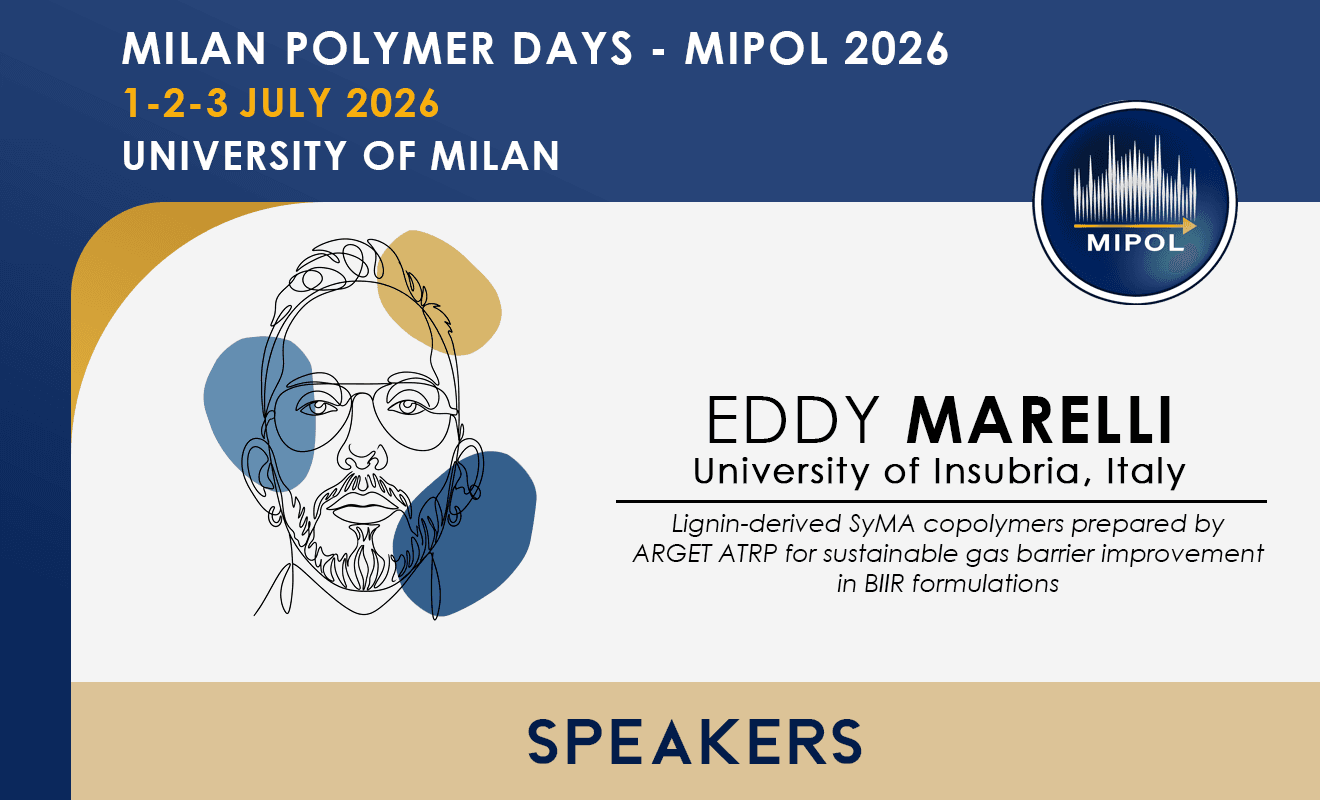
This work aims at developing polymer-based materials with lower air permeability than industrial bromobutyl rubber (BIIR)-containing formulations, while simultaneously increasing the renewable fraction of the final formulation. Lignin, the largest renewable source of aromatic building blocks, provides rigid phenolic structures capable of enhancing intermolecular interactions and reducing free volume in polymeric materials, two key factors governing gas transport [1,2]. On this basis, syringaldehyde (Sy), a lignin-derived aromatic molecule, was selected to confer controlled rigidity and reduced free volume into a tailored copolymer architecture, owing to the presence of two methoxyl substituents on the aromatic ring. To render Sy polymerizable, a methacrylic moiety was introduced via esterification of the OH group, yielding the methacrylated monomer SyMA. SyMA was then copolymerized with butyl acrylate (BuAc) (Fig. 1) via ARGET ATRP, a controlled radical polymerization technique that enables precise molecular weight control through continuous regeneration of the activator, allowing polymerization under low catalyst concentrations [3]. Copolymer samples with varying SyMA molar fractions (0.55, 0.28, 0.16, 0.12) were synthesized and characterized by ¹H NMR spectroscopy, DSC, and TGA. The glass transition temperatures (Tg) of the copolymers varied systematically with composition and followed the Flory–Fox relationship, confirming the tunable segmental mobility of the system.
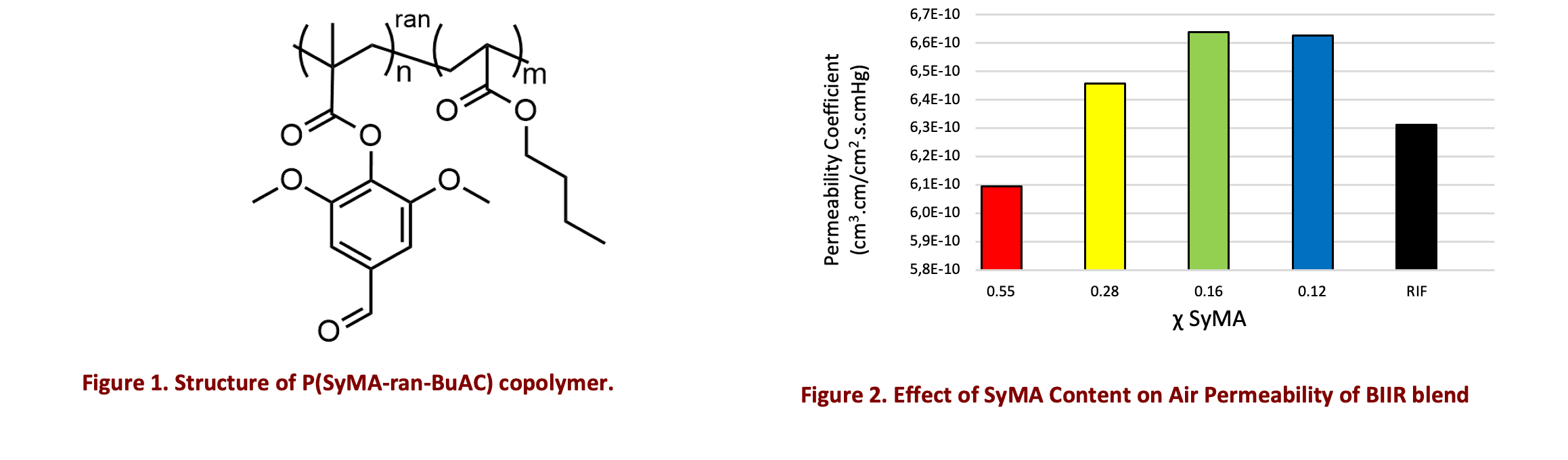
The copolymers were subsequently incorporated into an industrial BIIR blend. Filler dispersion and mixability remained comparable to that of the reference blend, indicating effective integration of the copolymer within the rubber matrix. Air permeability tests showed a measurable reduction of approximately 5% relative to the reference blend for the formulation containing the copolymer with the highest SyMA fraction (Fig. 2).
Overall, these results demonstrate that copolymers containing a lignin derivative monomer such as SyMA, produced via a green process, can be well integrated into industrial BIIR formulations to enhance the gas-barrier performance, highlighting their potential as sustainable macromolecular additives for advanced industrial applications.
References
1- N. Lee, Y. T. Kim, J. Lee Polymers 2021 13, 364.
2- R.V. Sankaranarayanan, S.H. Menon, S.C. Maniyeri, V.K. Periya, P. Naveenchandra ChemistrySelect 2025, 10, e04165.
3- K. Matyjaszewski Adv. Mater. 2018, 30, 1706441.
Acknowledgments
All the authors acknowledge financial support from the University of Insubria (FAR 2024) and Prometeon Tyre Group.