Investigation of carbon quantum dots in photoinduced ATRP: Strengths and limitations
Abstract
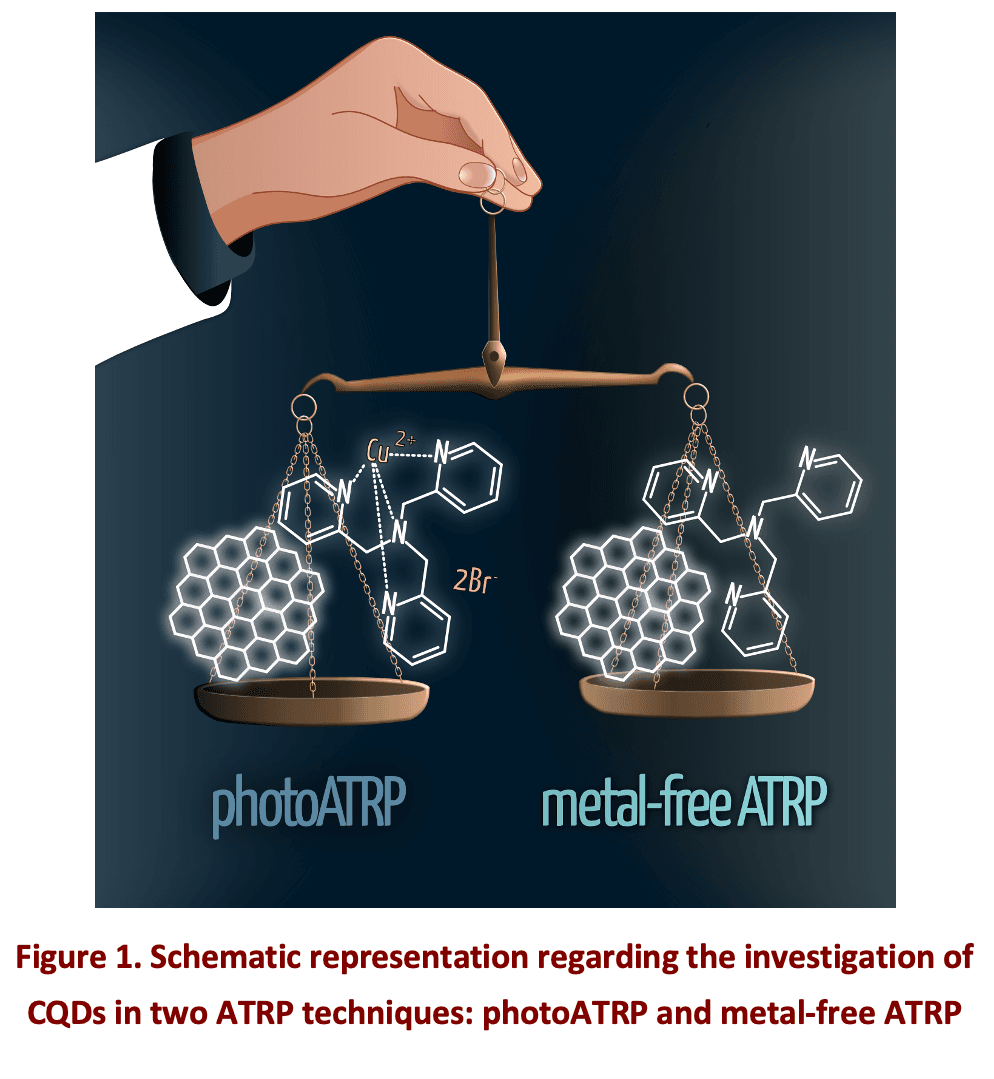
In the field of photocatalysis, researchers are increasingly focusing on developing greener and more efficient systems. Recently, carbon quantum dots (CQDs) have attracted significant attention due to their environmental friendliness, low toxicity, and strong light-harvesting capabilities. As a result, CQDs are emerging as promising alternatives to traditional organic photocatalysts. Their light-harvesting performance stems largely from surface states that can be modulated by electron-donating (e.g., −OH, −COOH) or electron-accepting (−NH₂) groups, directly influencing fluorescence, phosphorescence, and excited-state stability [1, 2]. By acting as either electron donors or acceptors, these nanostructures effectively mediate redox processes, facilitating the synthesis of well-defined polymers. Accordingly, CQDs are promising photocatalysts for atom transfer radical polymerization (ATRP), as was demonstrated in prior studies [1, 3]. Building on these reports, their performance in two different ATRP techniques: metal-free ATRP and photoATRP (Figure 1) was examined. Experiments were performed with CQDs synthesized from different precursors: citric acid (CQD-OH), citric acid with urea (CQD-NH₂), and citric acid with glutathione (CQD-S). Methyl methacrylate was selected as the model monomer, and its polymerization was performed in a heterogeneous photocatalytic system in N,N-dimethylformamide (DMF), while the reaction kinetics were systematically monitored. The main advantage of metal-free ATRP is its environmental friendliness, as the absence of metal catalysts reduces the need for purification. In contrast, photoATRP offers greater control over the activation and deactivation of the growing polymer chains. Consequently, this study details the photocatalytic mechanisms of CQDs in photoinduced ATRP and evaluates their comparative advantages and limitations in both methods.
References
1- K.Kisiel, I. Zaborniak, W. Zuba, C. Boyer, K. Matyjaszewski, P. Chmielarz, ACS Mat. Lett., 2025, 7(12), 3749
2- K. Yaemsunthorn, A. Sysło, D. Krok-Janiszewska, W. Kasprzyk, K. Spilarewicz, M. Pacia, W. Thongpan, M. Kobielusz, W. Macyk, J. Ortyl, Carbon, 2025, 234, 119967
3- C. Kütahya, Y. Zhai, S. Li, S. Liu, J. Li, V. Strehmel, Z. Chen, B. Strehmel, Angew. Chem., Int. Ed. 2021, 60, 10983
Acknowledgments
This work was supported by the National Science Centre (NCN) in Poland as a part of the PRELUDIUM BIS 5 project (UMO-2023/50/O/ST5/00104) entitled „Carbon quantum dots in the synthesis of functional polymeric materials using photoinduced atom transfer radical polymerization techniques”.