From food waste to sustainable polymers: bio-based poly(butylene succinate), copolymers, and blends for circular food packaging
Abstract
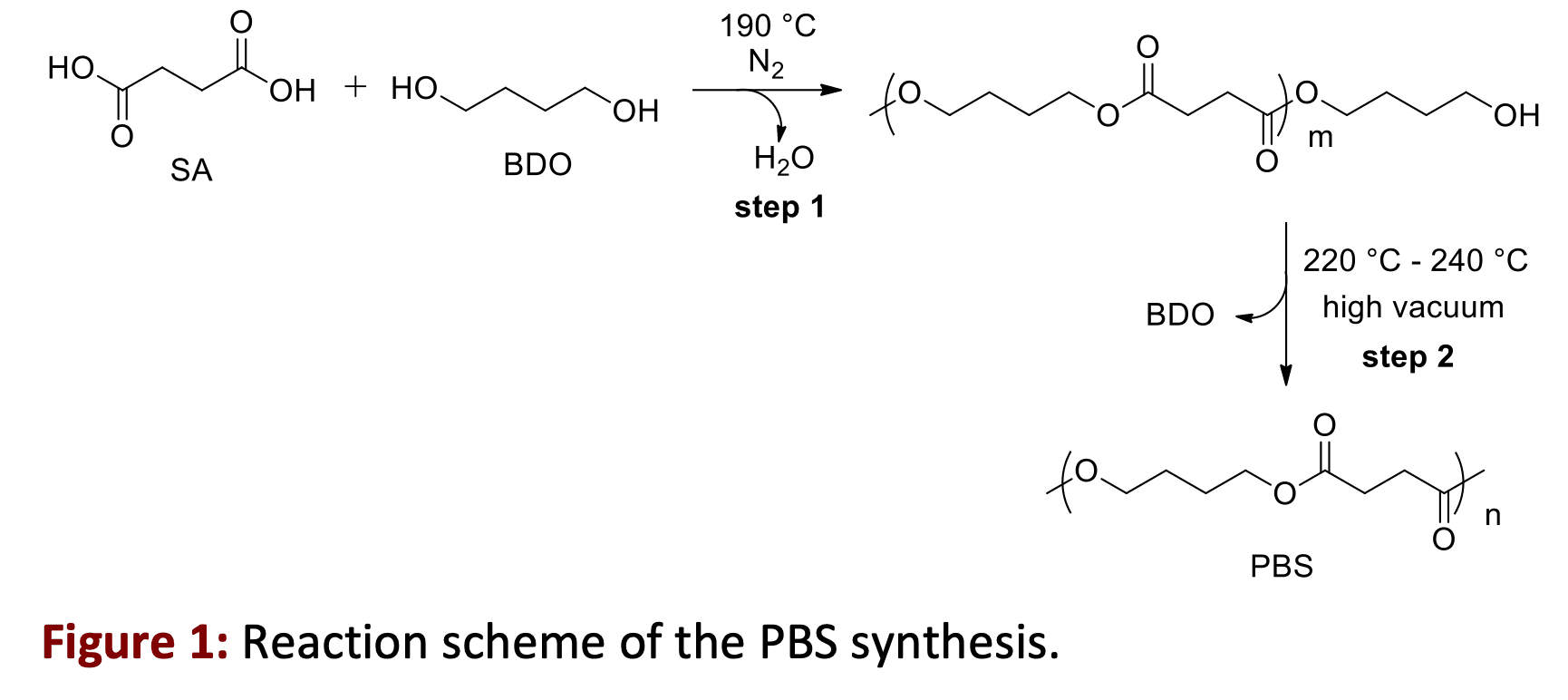
The integration of biorefinery feedstocks, renewable monomers, and polymer recycling strategies highlights a circular approach to polymer production, minimizing waste and environmental impact [1]. Based on this concept, poly(butylene succinate) (PBS) was synthesized using succinic acid derived from food waste through chemo-enzymatic process, providing a fully renewable alternative to petroleum-based polyester [2]. PBS, as reported in Fig. 1, was synthesized via a two-step melt polycondensation process. In the first step, bulk esterification of succinic acid (SA) and 1,4-butanediol (BDO) was carried out under a nitrogen atmosphere to remove the water formed during the reaction. In the second step, the resulting prepolymer underwent bulk transesterification under high vacuum, promoting chain growth and increasing the molecular polymer weight.
Reaction conditions were carefully controlled to ensure high purity and desirable thermal and mechanical properties of the final PBS. Comparative analysis shows that bio-based PBS exhibits thermal and mechanical properties similar to commercial PBS, while significantly reducing the carbon footprint and promoting circularity in the polymer production chain. In parallel, fully bio-based co-polyesters and their blends were developed by combining 1,4-butanediol and succinic acid with other biorefinery-derived monomers, including furan di carboxylic acid (FDCA), adipic acid and isosorbide. Moreover, glycerol [3] was employed as both chain extender and branching agent, in order to obtain novel co-polyesters with properties such as stiffness, flexibility, and processability, targeting applications in sustainable food packaging [4]. This study underscores the potential of fully bio-based polymers to replace conventional plastics while supporting a circular, low-carbon, and biodegradable material economy.
References
1- R. Taylor, L. Nattrass, G. Alberts, P. Robson, C. Chudziak, A. Bauen, I.M. Libelli, G. Lotti, M. Prussi, R. Nistri, D. Chiaramonti, A.M. López-Contreras, H.L. Bos, G. Eggink, J. Springer, R. Bakker, R. van Ree, From the Sugar Platform to biofuels and biochemicals: Final report for the European Commission Directorate-General Energy, 2015.
2- S. A. Rafiqah, A. Khalina, A. S. Harmaen, I. A. Tawakkal, K. Zaman, M. Asim, M. N. Nurrazi, C. H. Lee Polymers, 2021, 13, 1436.
3- Y. Chen, J. Xu, Y. Chen, C. Wang, H. Wang, J. Wu, Polym. Chem., 2025, 16, 1072.
4- D. Nath, M. Misra, F. Al-daoud, A. K. Mohanty, Food Packag. Shelf Life, 2022, 31, 100803.
Acknowledgments
This work was supported by the LUCRA project. The project has received funding from the European Union under grant agreement No 101112452.