Evaluation of quick changes in polymer rheology through high frequency CHIRP on an SMT rheometer
Abstract

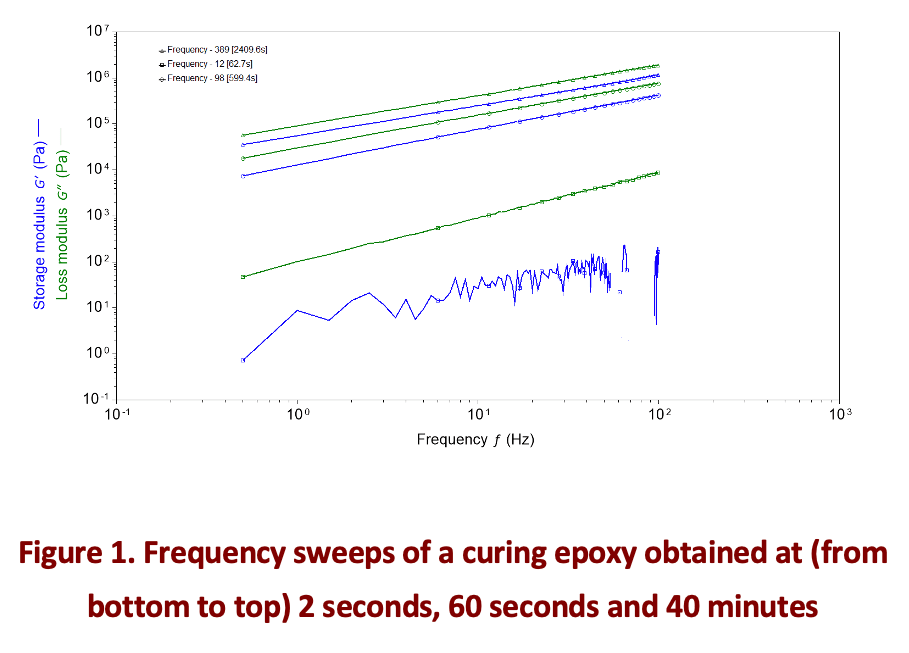
Rheology is a powerful tool to assess polymer properties down to the molecular structure [1] and is essential for process optimization. That is true for all kind of polymers: thermoplastics, thermosetting, elastomers. Frequency sweep tests provide important information about relaxation times and the zero rate viscosity, which are correlated to the molecular weight, the branching structure and other important properties of the polymer chain. Monitoring isothermal curing processes as they develop can give important insight on the curing process of thermosets and provide data for process optimization. However, some polymers tend to change on a time scale that can be shorter than that of the experiment, either because they cure very quickly or they are thermally unstable or suffer from oxidation. A better approach should be taken to characterize such materials. In this work we present results obtained using Fast Sampling CHIRP technology [2] [3] integrated on an Separate Motor and Transducer (SMT) Rheometer in order to take advantage of the superior strain control of such configuration [4].
References
1- M. T. Shaw, Introduction to Polymer Rheology, 2012, Hoboken, NJ, Wiley
2- R. E. Hudson-Kershaw, M. Das, G. H. McKinley, D. J. Curtis J. Nonnewton. Fluid Mech., 2024, 333, 105307.
3- M. Geri, B. Keshavarz, T. Divoux, D. J. Curtis, G.H. McKinley Phys. Rev. X, 2018, 8, 041042 .
4- A. Franck Annual Transactions of the Nordic Rheology Society, 2003, 11