Environmental safety of functionalized nanocellulose in marine systems: biological responses and interaction with venlafaxine
Abstract

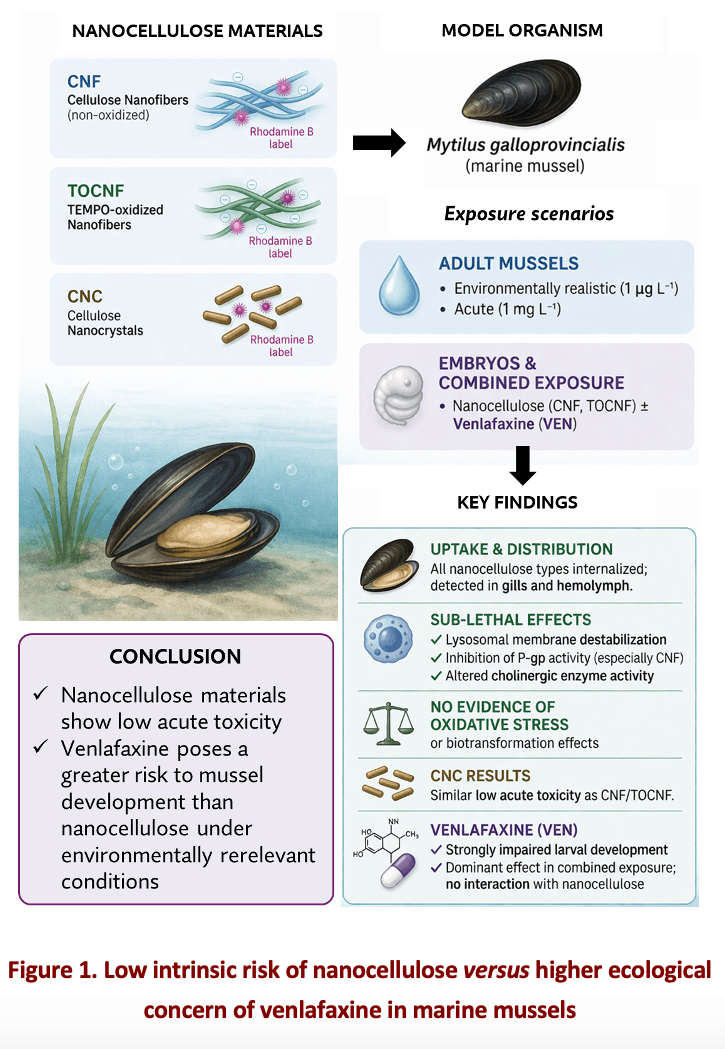
The increasing use of nanocellulose-based materials raises concerns about their potential release into aquatic environments and the need for comprehensive ecotoxicological assessment. In this study, we investigated the environmental safety of different nanocellulose systems, including cellulose nanofibers (CNF), TEMPO-oxidized nanofibers (TOCNF), and cellulose nanocrystals (CNC), using the marine bivalve Mytilus galloprovincialis as a model organism. Fluorescently labeled nanomaterials (Rhodamine B-functionalized CNF/TOCNF and CNC) were employed to evaluate uptake, biodistribution, and biological responses under environmentally relevant and acute exposure conditions [1]. Both CNF and TOCNF were internalized by adult mussels, accumulating in gills and hemolymph, and induced sub-lethal effects, including lysosomal membrane destabilization, inhibition of P-glycoprotein activity, and alteration of cholinergic enzyme activity. However, no significant oxidative stress or biotransformation responses were observed [1]. Similarly, CNC showed comparable behavior, confirming a consistent pattern of low acute toxicity across different nanocellulose morphologies. To further assess potential environmental risks, single and combined exposures with the pharmaceutical contaminant venlafaxine (VEN) were investigated on mussel embryos. While CNF and TOCNF alone did not significantly affect embryonic development, except for a slight reduction in embryo size, VEN exhibited a pronounced impact, impairing larval development likely through interference with serotonin-regulated pathways. In combined exposure scenarios, VEN effects dominated, with no evidence of synergistic or antagonistic interactions, suggesting limited adsorption or carrier effects of nanocellulose in filtered natural seawater [2]. Overall, these findings indicate that nanocellulose materials, regardless of morphology or surface functionalization, exhibit low acute toxicity toward M. galloprovincialis, while co-existing contaminants such as venlafaxine may represent a more significant ecological risk. This study contributes to the understanding of nanocellulose behavior in marine systems and supports future risk assessment within realistic environmental scenarios.
References
1- T. Rusconi, L. Riva, C. Punta, M. Solè, I. Corsi Env. Sc. Nano 2024, 11, 61.
2- A. Morgillo, F. Salatiello, C. Punta, L. Riva, A. Spagnuolo, E. D’Aniello, I. Corsi, F. Ristoratore, submitted.
Acknowledgments
This study was carried out within the RETURN Extended Partnership and received funding from the European Union Next-GenerationEU (National Recovery and Resilience Plan – NRRP, Mission 4, Component 2, Investment 1.3 – D.D. 1243 August 2, 2022, PE0000005).