Electrospun polymeric nanofibrous membranes for water remediation: integrating synthetic and bio-based matrices with functional particles
Abstract
Water contamination resulting from anthropogenic activities represents a critical threat to ecosystems and human health, driving the need for efficient, sustainable, and selective purification technologies. In this context, electrospun nanofibrous membranes have emerged as a promising platform due to their high surface area, tunable structure, and versatility in material design.
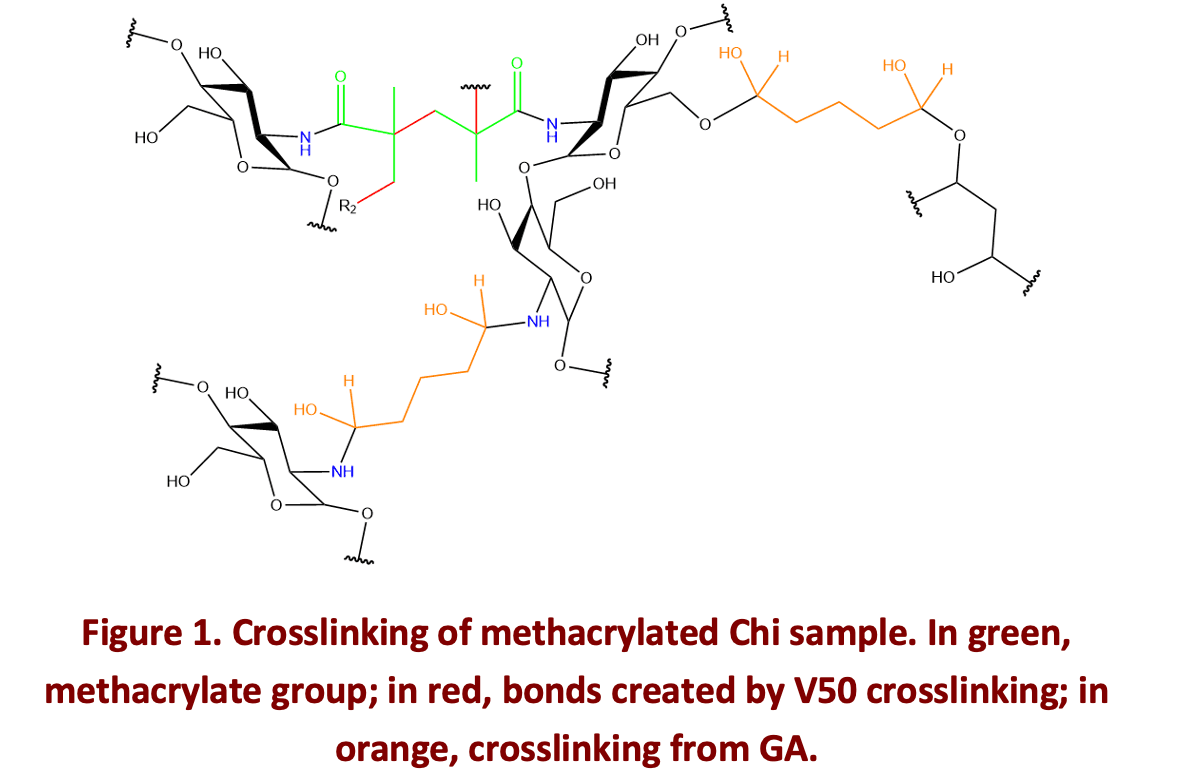
Natural polymer-based systems have been widely explored as environmentally friendly alternatives for water treatment. In this work, methacrylated chitosan and alginate membranes were processed via electrospinning and subsequently stabilized through different crosslinking strategies, including V50 thermal initiator and glutaraldehyde (GA) vapor (Fig. 1).
These approaches were essential to enhance membrane stability in aqueous environments while preserving their adsorption capacity. Additionally, biochar-derived particles were incorporated into the biopolymeric matrices to further improve performance, taking advantage of their high surface area and porosity, as well as their strong affinity for organic contaminants.
In parallel, synthetic polyurethane (PU) systems with tailored soft and hard segments were synthesized and evaluated for their suitability in electrospinning. Thermal and spectroscopic characterization (ATR-FTIR, DSC, and TGA) confirmed successful polymer formation and highlighted the influence of composition on processability and final membrane properties. Selected PU formulations exhibited appropriate solubility and spinnability, leading to homogeneous nanofibrous mats with average fiber diameters around 500 nm. To further enhance adsorption performance, UiO-66-NH₂ metal–organic framework (MOF) particles were incorporated into the polymer solutions prior to electrospinning, enabling their stable immobilization within the fibrous structure and promoting specific interactions with pollutants.
The resulting hybrid membranes, both bio-based and synthetic, exhibited enhanced adsorption capacity toward methylene blue, used as a model synthetic dye representative of textile industry effluents. This improvement is attributed to the synergistic combination of polymer matrix properties, nanofibrous architecture, and functional particle incorporation, which collectively increase effective surface area and interaction mechanisms such as electrostatic attraction and π–π stacking.
Overall, these results demonstrate the potential of electrospun membranes based on both natural and synthetic polymers as scalable and efficient platforms for water remediation, combining structural versatility, functional tunability, and environmental compatibility. Keywords: Electrospinning; Polyurethane; Biopolymers; Water remediation; Adsorption; MOF; Biochar; Methylene blue.