Dynamically crosslinked polyethylene-like materials with reversible self-reporting properties
Abstract
In line with the principles of the circular economy,[1] it is essential not only to recycle thermosets, but also to extend their service life to preserve value and sustainability. In this context, thermosetting materials remain particularly challenging, since conventional recycling methods often lead to poor-quality products, high energy consumption, or complex purification steps.[2] Covalent adaptable networks (CANs) offer a promising alternative, as they can be reshaped or repaired under external stimuli such as heat or light owing to the presence of reversible or exchangeable bonds.[3, 4]
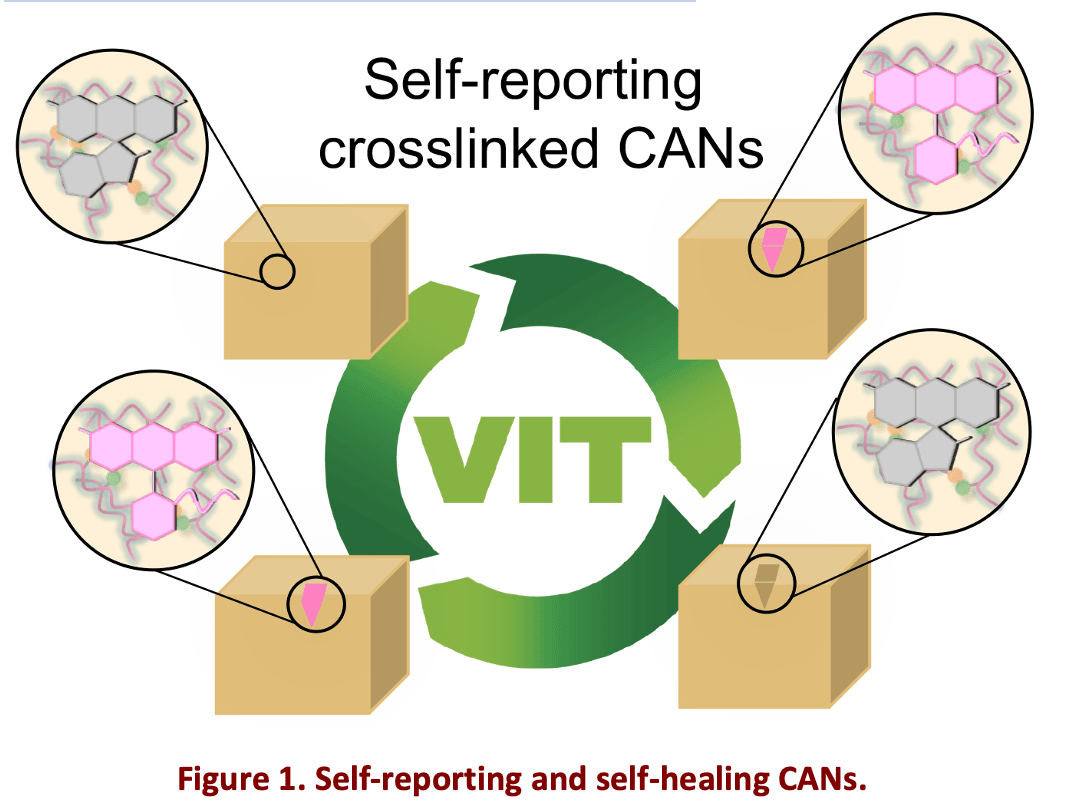
Effective detection of fractures and damage is equally important for prolonging the lifetime of polymeric materials. Mechanochromic probes are especially attractive for this purpose, as they change their UV-vis absorption spectrum upon mechanical activation, resulting in a red shift of the absorption maximum. Typically, this change in absorption is due to the change of conjugation in the molecule structure, providing a visible signal of localized stress, strain, or damage.
Examples of novel self-reporting and self-healing thermosets based on dynamic chemistries will be presented [5, 6] In these materials, the mechanochromophore acts as a dynamic crosslinker, since it contains functionalities capable of forming reversible covalent bonds in the polymer network. This design combines reversible self-reporting with self-healing ability, allowing damage to be detected in real time and repaired promptly, thereby reducing waste and improving sustainability. Notably, both functionalities can be fully restored by simple thermal treatment of the damaged area, demonstrating the robustness and reusability of these materials.
References
1- https://www.ellenmacarthurfoundation.org/topics/circular-economy-introduction/overview
2- E. Morici, N. T. Dintcheva Polymers 2022, 14, 4153.
3- J. M. Winne, L. Leibler, F.E. Du Prez Polym. Chem. 2019, 10, 6091.
4- S. Maes, V. Scholiers, F.E. Du Prez Macromol. Chem. Phys. 2023, 224, 2100445.
5- A. Torri., C. Paravidino, G. Giovanardi, F. Rispoli, F. Moroni, A. Pedrini, E. Dalcanale, A. Fina, R. Pinalli Mater. Horiz. 2025, 12, 4396.
6- R. Nicolella Gentile, G. Giovanardi, G. Campos, E. Pellegrino, A. Pedrini, E. Dalcanale, A. Fina, R. Pinalli in press.
Acknowledgments
All the authors acknowledge financial support acknowledge the project VIT, funded through the European Union Horizon 2020 Program (H2020-MSCA-RISE-2020 under grant agreement no. 101008237).