Digitally supported synthesis and fabrication of polymer-based membrane adsorbers for carbon capture
Abstract
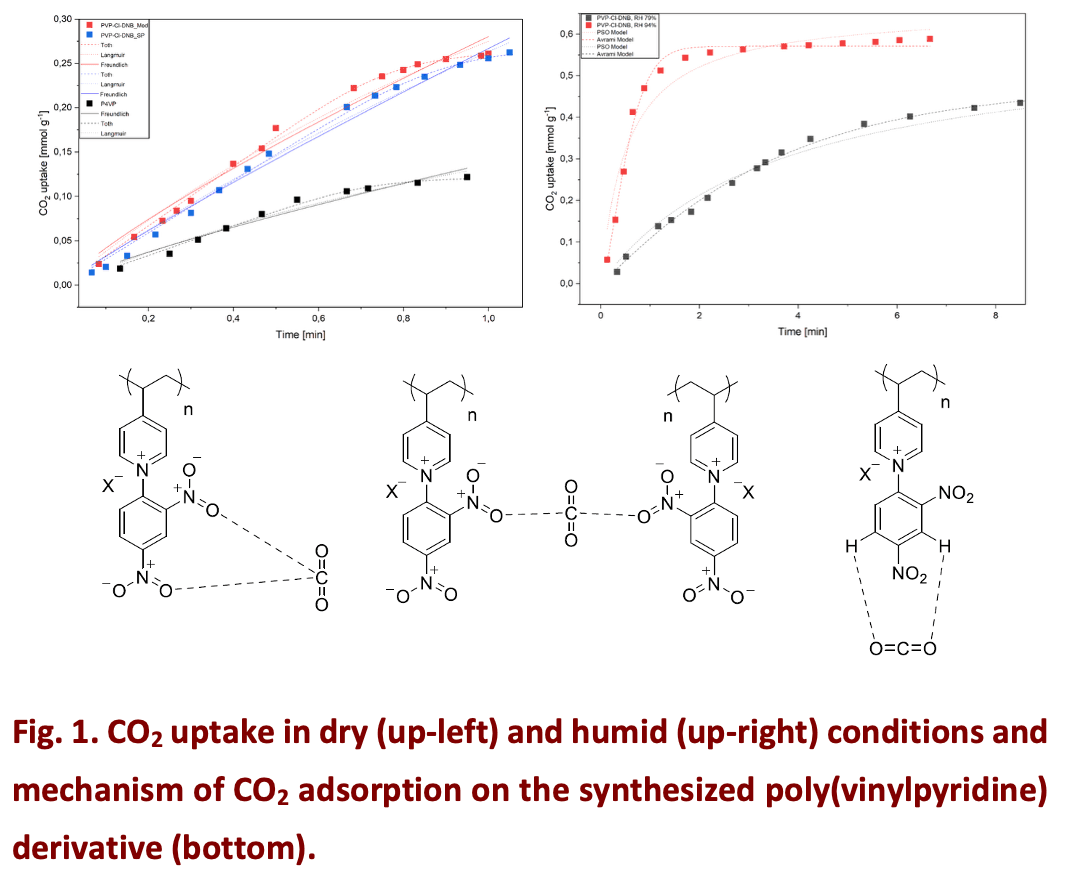
The transition toward climate‑neutral industrial processes requires novel materials capable of efficiently capturing CO2 from concentrated gas streams along with the rest of CO2 that is released in the atmosphere. Polymer‑based membrane adsorbers efficiently capture CO2 from concentrated gas streams, along with the rest of CO2 that is released. Polymers incorporating CO₂‑responsive functional groups, present a compelling solution due to their tunable chemistry, reduced energy demand and modular processing. This work presents an integrated digital-experimental framework for the accelerated development of such CO2 adsorber materials, with emphasis on RAFT polymerization design, process control, and performance optimization. Our approach begins with the digital design of CO₂‑responsive polymers based on acrylamide [1-3] and modified poly(4-vinylpyridine) [4]. Digital tools guide monomer selection, copolymer ratios, and target molecular weights, significantly reducing the number of physical experiments required. This methodology is supported by detailed kinetic modeling studies, which can efficiently describe the complex interplay among initiation, propagation, chain transfer and termination processes in RAFT polymerization. Special attention is given to oxygen inhibition [5] and its impact on initiation delays, chain‑end fidelity, and livingness factors critical for producing well‑defined block copolymers intended for membrane integration. A digital twin of the polymerization process is implemented to simulate reaction progression and optimize reaction conditions for scale‑up. This predictive environment enables the screening of reaction scenarios, including variations in monomer concentration, RAFT agent structure, temperature, and oxygen contamination levels. The digital predictions are then validated experimentally through controlled synthesis of homopolymers, random copolymers and block copolymers known for strong CO₂ affinities. Using re‑initiated oxygen‑inhibited RAFT polymerization strategies, we achieve, in addition to the control over molecular weight, dispersity and functional group placement, along with the avoidance of unsuccessful into membrane adsorbers via the solution casting technique. Their CO₂ synthesis trials. The synthesized polymers are subsequently processed responsiveness is systematically evaluated in terms of sorption capacity, adsorption kinetics, cyclic stability, and environmental robustness. Across all materials, digitally guided synthesis correlates with measurable improvements in CO₂ uptake. The study highlights how digitally supported synthesis reduces development time, minimizes experimental iterations, and ensures scalability from laboratory‑scale reactions to pilot‑scale fabrication processes. Overall, this work demonstrates a digital–experimental methodology for producing next‑generation CO₂‑responsive membrane adsorbers. By combining kinetic modeling, oxygen‑inhibition analysis, RAFT polymerization control, and membrane performance evaluation, and CO2 sorption process under realistic direct air capture conditions, we establish a replicable platform for designing polymeric materials tailored for carbon capture. The resulting workflow exemplifies how digitalization can transform polymer synthesis and enable rapid material innovation for climate‑relevant applications.
References
1- E. Pashayev, P. Georgopanos Macromol. Mater. Eng. 2025, 310, 2400290.
2- E. Pashayev, P. Georgopanos Polymers 2025, 17, 1115.
3- E. Pashayev, P. Georgopanos J. Mater. Chem. A 2026, DOI: 10.1039/D5TA10366E
4- E. Pashayev, F Kandelhard, P Georgopanos Macromol. Reaction Eng. 2023, 17, 2200068
5- F. Chatzidis, E. Pashayev, F. Kandelhard, P. Georgopanos RSC Appl. Polym. 2026 submitted
Acknowledgments
Funding from the Initiative and Networking Fund of the Helmholtz Association, project DACStorE (KA2-HSC-12), is gratefully acknowledged. S. Neumann, I. Ternes, and M. Brinkmann are especially thanked for thermal analysis and gel permeation chromatography experiments.