Development of CO2 polymer membrane adsorbers for direct air capture applications
Abstract

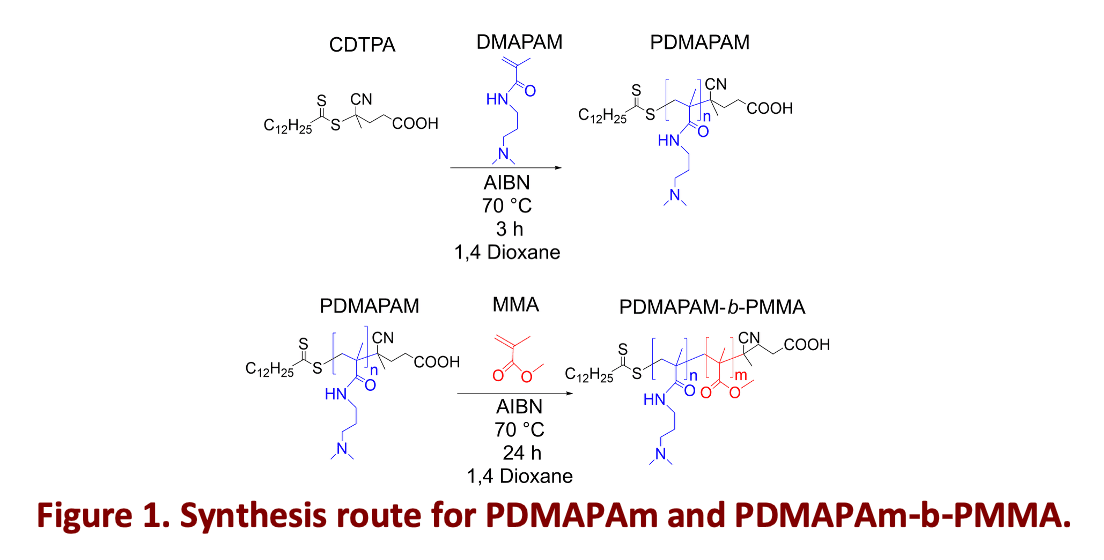
This study centers on the digital and experimental development of CO₂‑membrane adsorbers using newly designed polymers for CO2 capture. It includes synthesizing novel polymers, studying their polymerization kinetics, and evaluating their CO₂‑capture behavior through experimental and modeling approaches. Finally, polymerization and CO2 adsorption kinetics are integrated into a unified model to optimize both material properties and operating conditions for membrane adsorber‑based CO₂ capture. The polymer developed in this work is block copolymers poly(N‑[3‑(dimethylamino)propyl]acrylamide)‑b‑poly(methyl methacrylate) (PDMAPAm‑b‑PMMA), synthesized through a two‑step RAFT polymerization process. In the first stage, DMAPAm is polymerized in solution to synthesize the PDMAPAm block. In the second polymerization step, the pre‑synthesized PDMAPAm block was used as a macro‑RAFT agent and the chain of PDMAPAm was extended with methyl methacrylate (MMA), producing the well‑defined PDMAPAm‑b‑PMMA diblock copolymer as illustrated [1] in the Fig. 1.
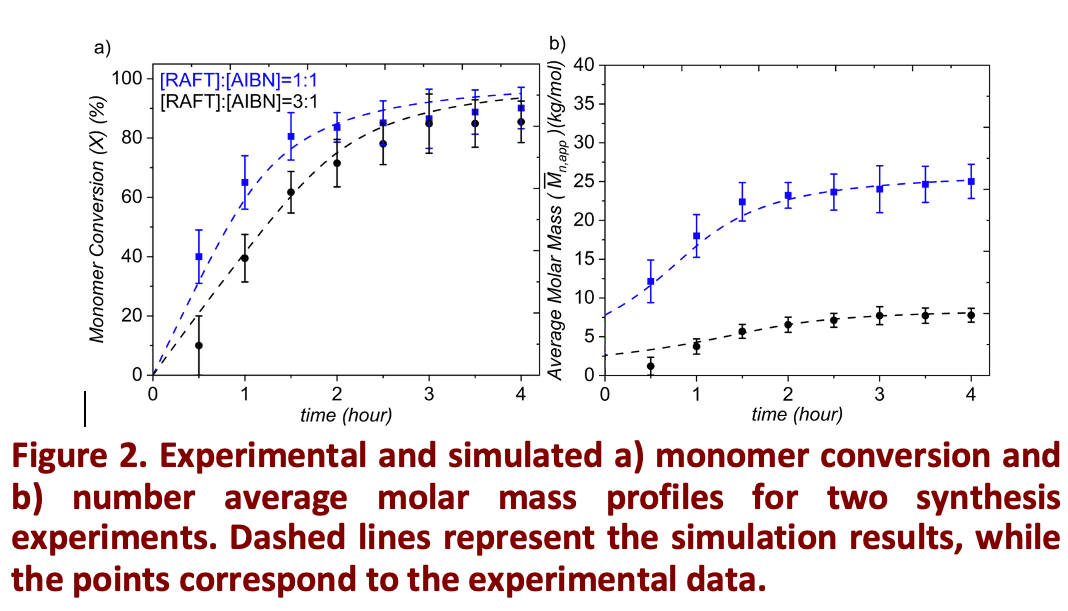
In addition, a kinetic model for RAFT polymerization of DMAPAm [2] was developed and validated using two independent kinetic datasets and shown to accurately predict the polymerization behavior, as presented below (Fig. 2).
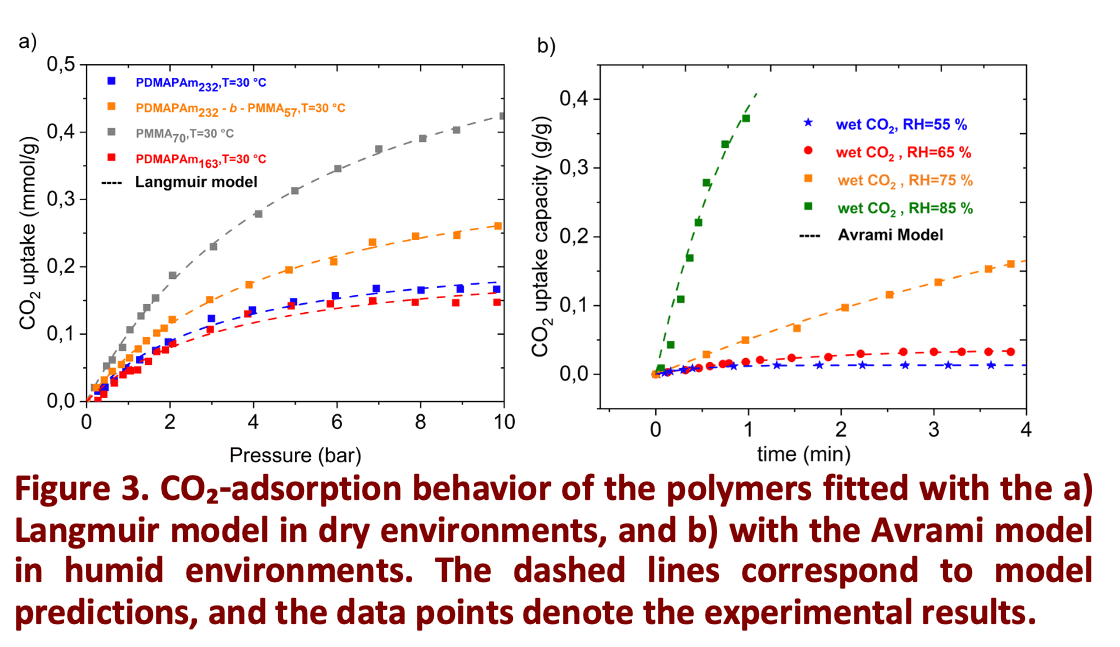
Moreover, the polymer’s CO₂‑uptake behavior was examined, revealing separate mechanisms associated with physisorption and chemisorption by conducting adsorption experiments under both dry and humid environments. Multiple adsorption models were tested by fitting the experimental uptake curves from dry and humid conditions to their respective simulations. The best agreement between experiment and simulation was obtained with the Langmuir model in dry conditions, indicating physisorption‑dominated uptake, whereas the Avrami model provided the closest fit under humid conditions, capturing the combined effects of chemisorption and humidity‑assisted interactions [3,4] as illustrated in the Fig.3.
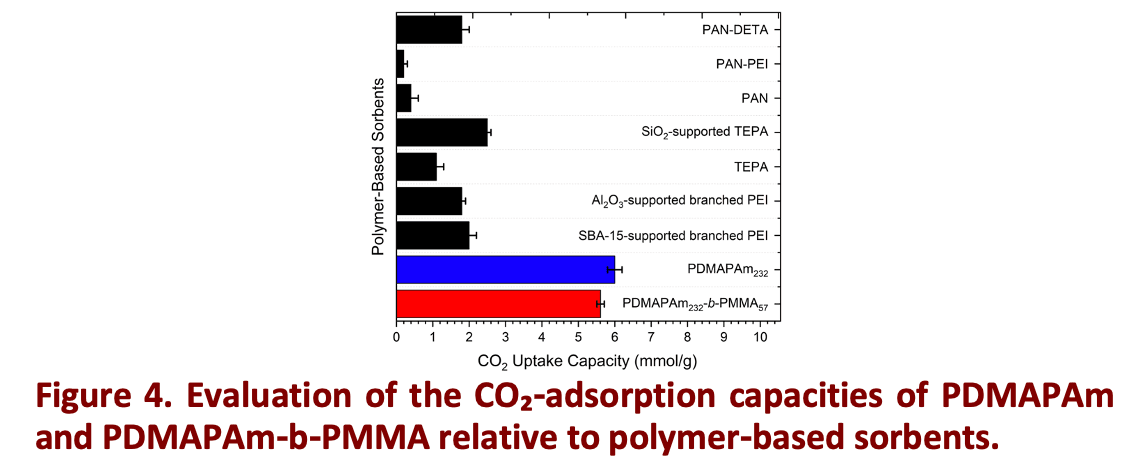
Ultimately, the kinetics of both polymerization and CO₂ adsorption considering Langmuir and Avrami models were integrated through a unified model. This unified model enables predictive tuning of polymer architecture and operating conditions for efficient CO₂ capture. Applying this model shows that optimized PDMAPAm and PDMAPAm‑b‑PMMA achieve 6 mmol/g CO₂ uptake at 80% RH under ambient conditions [4], outperforming common amine‑based sorbents such as TEPA and PEI (Fig. 4), demonstrating a strong potential for industrial Direct Air Capture applications or other advanced CO₂‑capture technologies.
References
1- E. Pashayev, P. Georgopanos Macromol. Mater. Eng. 2025, 310, 2400290.
2- E. Pashayev, P. Georgopanos Polymers 2025, 17, 1115.
3- E. Pashayev, P. Georgopanos J. Mater. Chem. A 2026, DOI: 10.1039/D5TA10366E
4- E. Pashayev, P. Georgopanos Material Horizons 2026, under revision.
Acknowledgments
Funding from the Initiative and Networking Fund of the Helmholtz Association, project DACStorE (KA2-HSC-12), is gratefully acknowledged.