Cationic sucrose-containing polymers for modified release drug delivery systems
Abstract
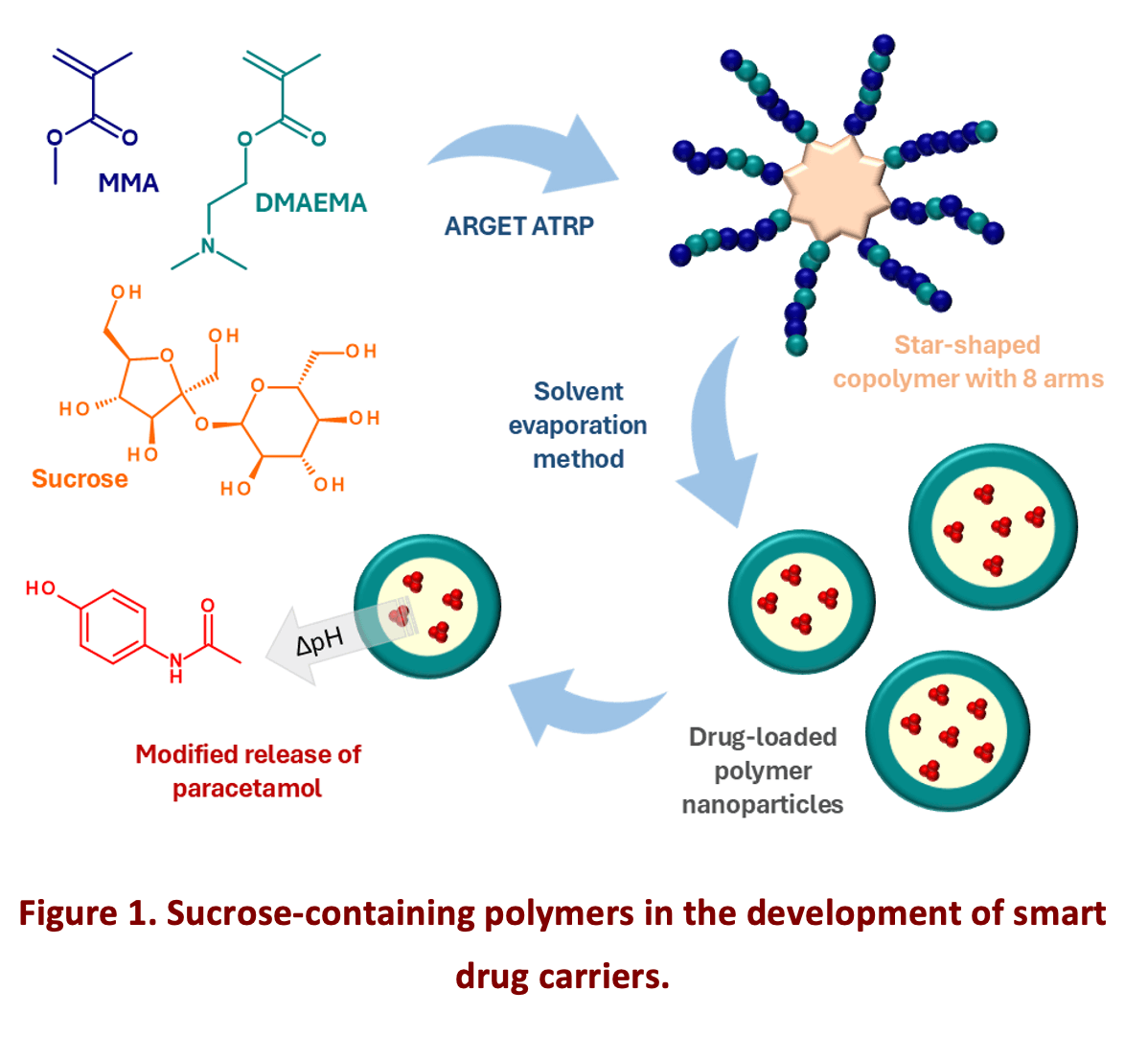
The therapeutic effect of many orally administered drugs depends closely on the kinetics of their release, which is influenced by the physiological environment of the gastrointestinal tract. Control of the targeted location and release rate of the active substance is possible using pH-sensitive ionic polymers. These include, for example, commercially available Eudragit E compounds, which are linear random copolymers of methyl methacrylate (MMA), n-butyl methacrylate (nBMA), and 2-(dimethylamino)ethyl methacrylate (DMAEMA). When exposed to low pH (characteristic of the stomach’s physiological environment), they change from a globular form to an extended form as a result of protonation of amino groups. For this reason, they are commonly used in the design of solid forms of drugs with prolonged release [1,2]. When designing polymeric drug delivery systems, it is extremely important to maintain control over the architecture and molecular weight of the polymer, which ensures a repeatable release profile of the active substance. This is feasible using reversible-deactivation radical polymerization (RDRP) techniques, which include activators regenerated by electron transfer atom transfer radical polymerization (ARGET ATRP) [3,4]. During the research, it was proposed to replace the linear macromolecules currently in use with branched polymers with star topology. ARGET ATRP was successfully used to synthesize star-shaped random copolymers of MMA and DMAEMA with a sucrose core. This resulted in a set of macromolecules with varying ionic segment content, which is sensitive to pH changes. The received polymers were subsequently utilized to prepare paracetamol-loaded nanoparticles as model drug carriers using the solvent evaporation method (Fig. 1). The size and uniformity of nanoparticle populations were examined using dynamic light scattering (DLS). The encapsulation efficiency of paracetamol and its release profile, depending on the environment (0.1 M hydrochloric acid or phosphate buffer with pH of 7.2) were subsequently evaluated with high-pressure liquid chromatography (HPLC). Due to the pH-dependent release profile of the active substance, the polymers obtained can be used in the design of solid oral dosage forms and drug delivery nanosystems for targeted therapy, e.g., cancer treatment.
References
1- A. Nikam, P.R. Sahoo, S. Musale, R.R. Pagar, A.C. Paiva-Santos, P.S. Giram Pharmaceutics 2023, 15, 587.
2- I. Zaborniak, A. Macior, P. Chmielarz Molecules 2021, 26, 1918
3- M. Sroka, I. Zaborniak, P. Chmielarz ACS Biomater. Sci. Eng. 2025, 11, 4694.
4- M. K. Yazdi, P. Zarrintaj, M. R. Saeb, M. Mozafari, S. A. Bencherif Prog. Mater. Sci. 2024, 143, 101248.
Acknowledgments
All the authors acknowledge financial support from the National Centre for Research and Development as part of the LIDER XIV project (no. LIDER14/0058/2023).