A novel chemical recycling process for PET waste: ammonium metallates as efficient and sustainable catalysts
Abstract
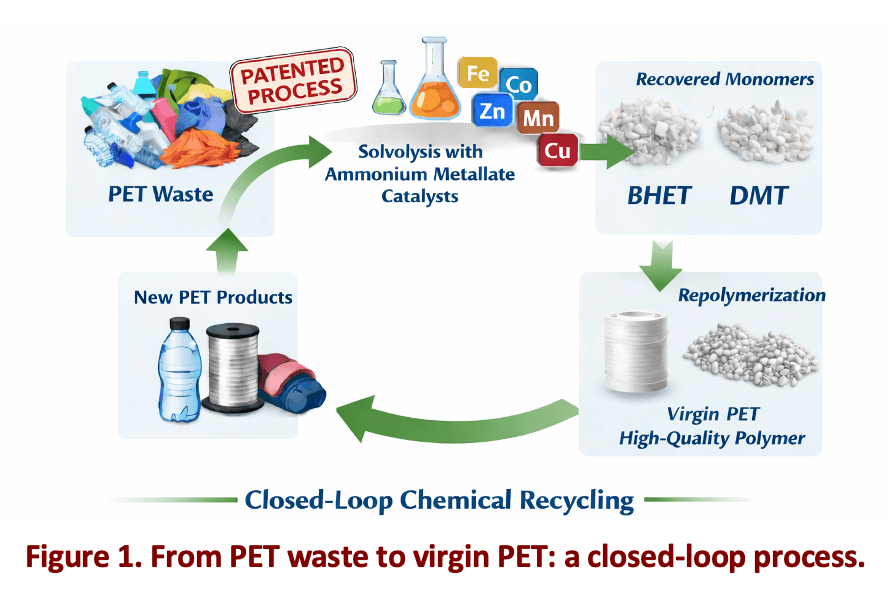
The transition from a linear economy to a circular economy is one of the most pressing challenges in dealing with the problem of plastic waste accumulation and resource depletion. In this context, polyethylene terephthalate (PET), widely used in packaging and textile applications, stands out as a key target for chemical recycling strategies [1]. This work reports a patented solvolytic process for the depolymerization of post-consumer PET, based on the use of simple metal complexes as efficient and sustainable homogeneous catalysts[2]. A series of ammonium metallates with general formulae [R4N]+[MIIIX4]-, [R4N]2+[MIIX4]2- and [R4N]+[MIIX3]-, derived from first-row transition metals (Fe, Mn, Co, Zn, and Cu)[3] were synthesized through simple and cost-effective procedures and tested in PET glycolysis, methanolysis, and ammonolysis. These catalytic systems allow PET depolymerisation to take place under relatively mild conditions, avoiding the use of toxic reagents, in line with green chemistry principles. Glycolysis and methanolysis proved to be particularly effective, obtaining bis(2-hydroxyethyl) terephthalate (BHET) and dimethyl terephthalate (DMT), respectively, in high yields and purity. In particular, microwave-assisted glycolysis allowed complete PET conversion within a few minutes, delivering good BHET yields, with cobalt- and iron-based metallates showing the best performances. The dual role of metallates as both catalysts and effective microwave absorbers eliminates the need for extra additives, further enhancing the sustainability of the process. Methanolysis reactions, carried out in autoclave, resulted in quantitative PET conversion and high DMT yields, highlighting the versatility of these systems across different solvolytic routes. The patented process was also successfully validated on real post-consumer waste streams without the need for prior sorting or expensive and time-consuming pre-treatment steps. Depolymerization was effective even with mixed plastic waste, colored and contaminated PET, and textile waste, including polyester-based fabrics and polyester–cotton blends. The tolerance toward contaminants and polymer mixture demonstrates the robustness of the method and its potential for industrial application. Moreover, the recycled monomers were directly reutilized in repolymerization reactions. Particularly, DMT obtained from methanolysis reactions was successfully repolymerized back into PET, demonstrating that the recovered monomer meets the quality standards for the production of virgin-grade polyester.
References
1- M. Babaei, M. Jalilian, K. Shahbaz J. Environ. Chem. Eng., 2024, 12.
2- Caselli, N. Panza, M. Ortenzi, G. Boni, Recycling process of polyesters from mixed plastic waste, WO2025052233, 2023.
3- N. Panza, M. Alberti, S. Galiè, C. Damiano, F. Cargnoni, M. I. Trioni, A. Caselli European J. Org. Chem. 2022, e202200908.